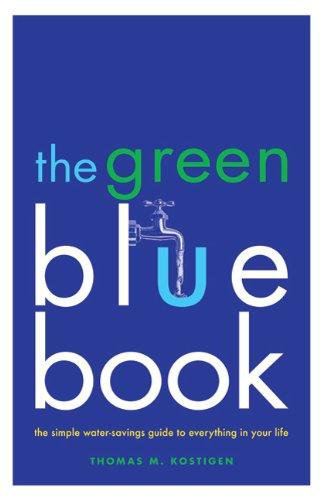
The Green Blue Book
0
0
As an Amazon Associate and affiliate partner, Menrva Books earns from qualifying purchases. Learn more
Author Description
Thomas M. Kostigen sets out to show how much water all the stuff in our lives really guzzles up. And how to make more water-conscious consumer choices every day. "We need to just start looking at the world through a blue prism," says Kostigen. Freshwater makes up less than 1 percent of the total volume of water on Earth. And that precious resource is quickly being not only wasted, but contaminated, too. In his book, Kostigen guides consumers into thinking about their choices in terms of water, and shows us where we're wasting it the most. For example, in the United States, 75 percent of residential water use goes to our lawns. The Green Blue Book is an easy-to-understand resource packed with hundreds of examples (from office supplies and flooring materials to fruit juices and travel options) that will help Americans -- who typically use 656,000 gallons of water a year -- make wiser choices for human and environmental health (after all, we all need clean water to survive). Certainly, household water conservation measures, such as taking a Navy shower and installing low-flow faucets, go a long way in saving water. But Kostigen's book challenges us to think about protecting our water in a different way -- by consuming less, and by pondering life-cycle water usage whenever we buy, whether it's food, building materials, clothing, or other stuff. - Publisher.
Menrva's Summary
THE THESIS
The Green Blue Book challenges consumers to re-evaluate their daily choices through the lens of water consumption. Thomas M. Kostigen argues that freshwater is a rapidly diminishing and increasingly contaminated resource, making conscious consumerism essential for both human and environmental survival. The book provides hundreds of examples, from office supplies to food choices, illustrating the hidden water footprint of everyday items and highlighting areas of significant waste, such as the 75% of residential water use in the US dedicated to lawns. Kostigen urges readers to consider the entire lifecycle of products and to reduce consumption by understanding the true water cost of their purchases.
THE SCOPE MAP
- Analysis of the hidden water footprint of everyday consumer goods.
- Hundreds of specific examples across various product categories (office supplies, food, clothing, travel).
- Data on typical water usage in the United States.
- Explanation of the concept of 'lifecycle water usage'.
- Discussion on the scarcity and contamination of freshwater resources.
- Guidance for making more water-conscious consumer choices.
- Emphasis on reducing consumption as a key water conservation strategy.
THE AUTHORITY PERSPECTIVE
The book is presented as an accessible resource for consumers seeking to understand and reduce their water footprint. It aims to shift perspectives by framing choices through a 'blue prism,' emphasizing the preciousness of freshwater. The publisher's description highlights its practical examples and its challenge to conventional conservation methods by focusing on consumption patterns. The text suggests the book is a guide for making wiser decisions for personal and planetary well-being.
Page Count:
0
Publication Date:
2010-01-01
ISBN-10:
1605294713
ISBN-13:
9781605294711
Non-Fiction
Science
Sustainability
Water Conservation
Consumerism
Lifestyle
Environment
Community Tags
Similar Books