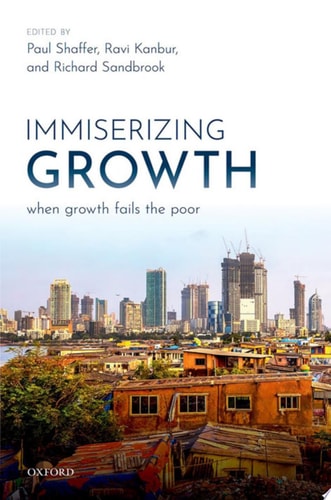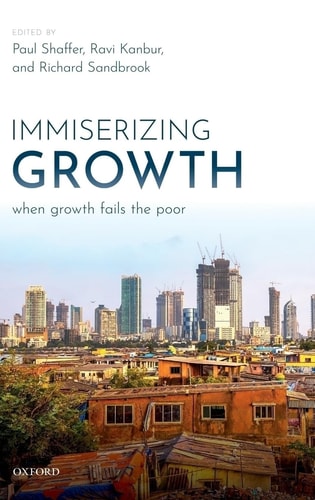
Immiserizing Growth: When Growth Fails the Poor
0
0
As an Amazon Associate and affiliate partner, Menrva Books earns from qualifying purchases. Learn more
Author Description
Immiserizing growth occurs when growth fails to benefit, or harms, those at the bottom. It is not a new concept, appearing in some of the towering figures of the classical tradition of political economy including Malthus, Ricardo, and Marx. It is also not empirically insignificant, occurring in between 10% and 35% of cases. In spite of this, it has not received its due attention in the academic literature, dominated by the prevailing narrative that 'growth is good for the poor'. Immiserizing Growth: When Growth Fails the Poor challenges this view to arrive at a better understanding of when, why, and how growth fails the poor.Taking a diverse disciplinary perspective, Immiserizing Growth combines discussion of mechanisms of this troubling economic phenomenon with empirical data on trends in growth, poverty, and related welfare indicators. It draws on political economy, applied social anthropology, and development studies, including contributions from experts in these fields. A number of methodological approaches are represented including statistical analysis of household survey and cross-country data, detailed ethnographic work and case study analysis drawing on secondary data. Geographical coverage is wide including Bolivia, the Dominican Republic, Ecuador, India, Indonesia, Mexico, Nigeria, the People's Republic of China, Singapore, and South Korea, in addition to cross-country analysis.This volume is the first full-length treatment of immiserizing growth, and constitutes an important step in redirecting attention to this major challenge.
Menrva's Summary
THE THESIS
This book investigates the economic phenomenon of immiserizing growth, a condition where national economic expansion fails to improve or actively worsens the welfare of the poorest populations. The authors, Paul Shaffer, Ravi Kanbur, and Richard Sandbrook, utilize a multidisciplinary framework to challenge the prevailing academic consensus that economic growth is inherently beneficial for the poor. By synthesizing classical economic theory with contemporary empirical data, they argue that growth-related poverty increases are a significant, under-researched reality in global development.
THE SCOPE MAP
What You Will Find
- Statistical analysis of household survey data and cross-country economic indicators.
- Ethnographic case studies examining specific regional outcomes in nations including India, Nigeria, and China.
- A multidisciplinary methodology integrating political economy, social anthropology, and development studies.
- An examination of the mechanisms that cause growth to bypass or harm the bottom deciles of a population.
THE AUTHORITY PERSPECTIVE
Experts recognize this volume as the first comprehensive academic treatment of immiserizing growth, filling a significant gap in development literature. Scholars frequently note the text's rigorous integration of both quantitative data and qualitative ethnographic research as a model for future economic inquiry.
Page Count:
304
Publication Date:
2019-04-28
Publisher:
Oxford University Press
ISBN-10:
0198832311
ISBN-13:
9780198832317
Economics
Public Policy
Social Science
Poverty
Economics