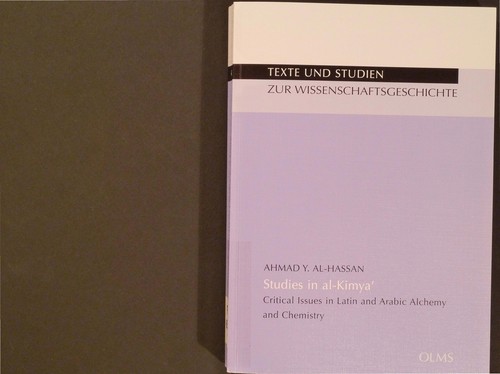
Studies in al-Kimya'
0
0
As an Amazon Associate and affiliate partner, Menrva Books earns from qualifying purchases. Learn more
Author Description
This book discusses eight critical issues in the history of Latin and Arabic alchemy and chemistry, which are currently accepted without concrete evidence, and are based mainly on conjecture.The essays in the book are based on extensive research into Arabic manuscripts and Latin literature. The results of this research are challenging. They prove the Arabic origin of the Summa Perfectionis and the other Geber Latin works. Thus the prevailing conjectures about assumed Latin authors are refuted on the basis of ample evidence. The book discusses the Arabic original of Liber de compositione alchimiae that was the first treatise on alchemy to appear in the West. It brings into light for the first time Jabir's book of recipes on the colouring of glass and his other chemical industrial recipes. An essay discusses potassium nitrate and nitric acid in Arabic and Latin sources. Both were known before the 13th century. Explosive gunpowder with the ideal formula and portable cannon were known in Arabic military treatises in the 13th century. The book gives an essay on the distillation of wine and alcohol since the eighth century. The final essay is on the composition of Damascus steel.--Publisher's description.
Menrva's Summary
THE THESIS
This book challenges prevailing conjectures about the origins and authorship of key alchemical and chemical texts by presenting new evidence from extensive manuscript research. The author, Aḥmad Yūsuf Ḥasan, critically examines eight issues in the history of Latin and Arabic alchemy, refuting widely accepted theories based on conjecture with concrete evidence. The essays draw upon extensive research into Arabic manuscripts and Latin literature to argue for the Arabic origin of influential works like the Summa Perfectionis and the first Western treatise on alchemy, Liber de compositione alchimiae. The findings also shed light on early knowledge of chemical industrial recipes, potassium nitrate, nitric acid, gunpowder, wine distillation, and the composition of Damascus steel, pushing back established timelines for these discoveries.
THE SCOPE MAP
- Analysis of the Arabic origin of the Summa Perfectionis and other Geber Latin works.
- Examination of the Arabic original of Liber de compositione alchimiae, the first alchemical treatise in the West.
- Revelation of Jabir's book of recipes on glass coloring and other chemical industrial applications.
- Discussion of the historical knowledge of potassium nitrate and nitric acid before the 13th century.
- Evidence for the knowledge of explosive gunpowder and portable cannon in 13th-century Arabic military treatises.
- An essay on the distillation of wine and alcohol dating back to the 8th century.
- An investigation into the composition of Damascus steel.
THE AUTHORITY PERSPECTIVE
This scholarly work is based on extensive research into primary sources, including Arabic manuscripts and Latin literature, offering a rigorous challenge to established historical narratives in alchemy and chemistry. The author's findings, particularly regarding the origins of key texts and early chemical knowledge, are presented as evidence-based arguments intended to correct widely held misconceptions. The book's focus on detailed textual analysis and historical evidence suggests it is aimed at specialists and researchers in the history of science and medieval studies.
Page Count:
320
Publication Date:
2009-01-01
ISBN-10:
3487142732
ISBN-13:
9783487142739
Non-Fiction
History
Alchemy
Chemistry
Community Tags
Similar Books