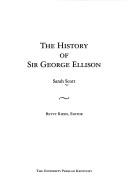
The History of Sir George Ellison
0
0
As an Amazon Associate and affiliate partner, Menrva Books earns from qualifying purchases. Learn more
Author Description
Sarah Robinson Scott (1720-1795), the author of novels, biographies, and histories, was born to many advantages of education and upbringing that made her a writer. But without a strong desire for financial independence, she might never have become a professional author. She saw a great advantage in being unmarried because only unmarried women were free to work toward their own ends. This theme was to be incorporated into her first novel and best known work, A Description of Millenium Hall (1762). The History of Sir George Ellison (1766) is a sequel to Millenium Hall. In it, Sir George, a visitor to the Hall, follows the pattern of the female utopia set forth in the earlier novel. Scott addresses issues of slavery, marriage, education, law and social justice, class pretensions, and the position of women in society. Throughout the book Scott consistently emphasizes the importance, for both genders and all classes and ages, of devoting one's life and most of one's time to meaningful work.
Menrva's Summary
THE PULSE
The tranquil utopia of Millenium Hall faces a subtle challenge when its ideals are tested by the arrival of Sir George Ellison, a man whose presence prompts a re-examination of the established order. Sir George, a visitor to the utopian community previously detailed, finds himself navigating the carefully constructed social fabric of Millenium Hall. The narrative explores his interactions and observations as he grapples with the principles of this female-centric society, while the author, Sarah Scott, uses his perspective to address critical issues of the era. The book delves into themes of slavery, marriage, education, law, social justice, class, and the societal position of women, all within the framework of a society striving for meaningful work and equitable living.
INSIDE THE PAGES
- Exploration of the sequel's narrative framework, following Sir George Ellison's engagement with the utopian society.
- Detailed examination of the social and ethical issues prevalent in the late 18th century, including slavery and the position of women.
- Analysis of marriage, education, and legal systems through the lens of the utopian community.
- Emphasis on the importance of meaningful work for all individuals, regardless of gender, class, or age.
- Thematic exploration of class pretensions and their impact on social harmony.
- Continuation of the philosophical and social ideals presented in 'A Description of Millenium Hall'.
- Character development of Sir George Ellison as he interacts with and reflects upon the community's principles.
THE COLLECTIVE ECHO
The History of Sir George Ellison, a sequel to Sarah Scott's 'A Description of Millenium Hall', continues to explore the author's interest in utopian societies and social reform. The novel engages with significant contemporary issues such as slavery, marriage, and the role of women, reflecting Scott's commitment to social justice. Its emphasis on the value of meaningful work for all members of society provides a consistent ethical throughline. The book serves as a valuable insight into the social and philosophical currents of the late 18th century, offering a perspective on idealized communities and their practical implications.
Page Count:
235
Publication Date:
1996-01-01
ISBN-10:
0813119383
ISBN-13:
9780813119380
Historical Fiction
Fiction
Social Commentary
Epistolary Novel
Community Tags
Similar Books