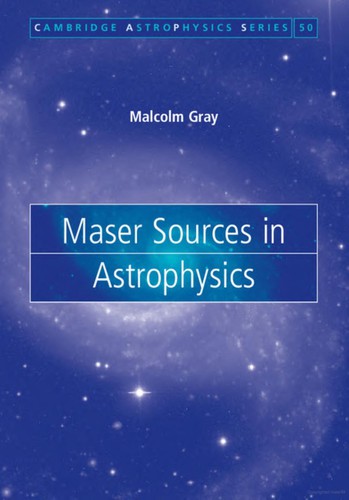
Maser Sources in Astrophysics
0
0
As an Amazon Associate and affiliate partner, Menrva Books earns from qualifying purchases. Learn more
Author Description
Masers are observed at a range of scales - from comets, through star-forming clouds, to galactic nuclei - and have many astrophysical applications, for example measuring cosmological distances. Written for postgraduate students and professional researchers in molecular astrophysics, this volume is an up-to-date survey of the theory and observations of astrophysical maser sources and their use as astronomical tools. The book summarizes the history of the discovery of various maser molecules and lines, and discusses maser observations on various scales. The theory is discussed in detail, including the quantum-mechanical response of the molecules, before being linked to more general radiation transfer. A discussion of spectral-line radio astronomy techniques shows how maser observations can be applied more generally to radio astronomy. The book introduces new and projected instruments, including ALMA and SKA. Additional topics address the radiation statistics of astrophysical masers, and numerical methods of analysis
Menrva's Summary
THE THESIS
This book provides a comprehensive survey of astrophysical maser sources, detailing their theory, observations, and applications. Written for postgraduate students and professional researchers, it covers the history of maser discovery, observations across various scales from comets to galactic nuclei, and the underlying quantum-mechanical principles. The text links theoretical maser physics to radiation transfer and discusses spectral-line radio astronomy techniques, highlighting how maser observations serve as astronomical tools.
THE SCOPE MAP
- A survey of astrophysical maser sources, including their theory and observations.
- Discussion of maser applications, such as measuring cosmological distances.
- Historical overview of the discovery of various maser molecules and lines.
- Detailed theory of maser physics, including quantum-mechanical responses and radiation transfer.
- Explanation of spectral-line radio astronomy techniques and their application to maser observations.
- Introduction to new and projected instruments like ALMA and SKA.
- Analysis of radiation statistics of astrophysical masers and numerical methods.
THE AUTHORITY PERSPECTIVE
This volume is presented as an up-to-date survey for postgraduate students and professional researchers in molecular astrophysics. It aims to consolidate current knowledge on astrophysical maser sources, linking theoretical underpinnings with observational data and practical applications in radio astronomy. The inclusion of new instruments suggests a focus on contemporary and future research directions within the field.
Page Count:
0
Publication Date:
2012-01-01
ISBN-10:
0521879809
ISBN-13:
9780521879804
Science
Physics
Astrophysics
Astronomy
Research
Community Tags
Similar Books