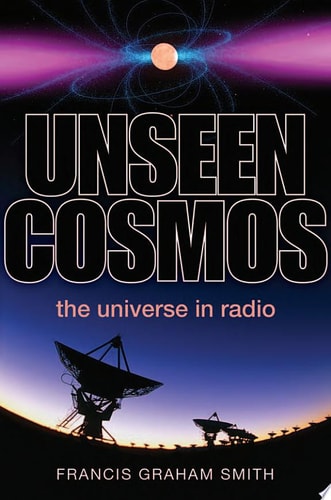
Unseen Cosmos
0
0
As an Amazon Associate and affiliate partner, Menrva Books earns from qualifying purchases. Learn more
Author Description
Radio Telescopes Have Transformed Our Understanding Of The Universe. Pulsars, Quasars, Big Bang Cosmology: All Are Discoveries Of The New Science Of Radio Astronomy. Here, Francis Graham-smith Describes The Birth, Development, And Maturity Of Radio Astronomy, From The First Discovery Of Cosmic Radio Waves To Its Present Role As A Major Part Of Modern Astronomy. Radio Is Part Of The Electromagnetic Spectrum, Covering Infra-red, Visible Light, Ultraviolet, X-rays, And Gamma-rays, And Graham-smith Explains Why It Is That Radio Waves Give Us A Unique View Of The Universe. Tracing The Development Of Radio Telescopes He Shows How Each New Idea In Observing Techniques Has Led To New Discoveries, And Looks At The Ways In Which Radio Waves Are Generated In The Various Cosmic Sources, Relating This To The Radio World Of Mobile Phones, Radio And Television Channels, Wireless Computer Connections, And Remote Car Locks. Today A New Generation Of Radio Telescopes Promises To Extend Our Understanding Of The Universe Into Further, As Yet Unknown, Fields. Huge New Radio Telescopes Are Being Built, Such As The Atacama Large Millimetre Array (alma), Low Frequency Array For Radioastronomy (lofar), And The Square Kilometre Array (ska). Radio Telescopes On Spacecraft Such As The Cosmic Microwave Explorer (cobe) And Planck Are Tracing In Minute Detail The Faint But Universal Radio Signal From The Expanding Early Universe. Graham-smith Shares The Excitement Of Discovering The Wonders Of The Radio Universe, And The Possibilities Promised By The New Age Of Giant Radio Telescopes.
Menrva's Summary
THE THESIS
How has the development of radio astronomy fundamentally altered our observational capacity and theoretical understanding of the cosmos? Francis Graham-Smith, a distinguished astronomer, utilizes his extensive background in the field to document the evolution of radio astronomy from its inception to its current status as a pillar of modern astrophysics. The book presents a framework that links the technical progression of radio telescope design with the resulting expansion of our knowledge regarding cosmic phenomena such as pulsars and the early universe. By bridging the gap between terrestrial radio technology and celestial signal detection, the author argues that radio waves provide a unique, indispensable window into the electromagnetic spectrum.
THE SCOPE MAP
What You Will Find
- Historical development of radio astronomy from early cosmic wave detection to modern arrays.
- Technical explanations of how radio waves are generated in various cosmic sources.
- Comparative analysis of radio technology in daily life versus astronomical instrumentation.
- Overview of current and future projects including ALMA, LOFAR, and the Square Kilometre Array.
Scope Limits
- Does not provide a comprehensive mathematical derivation of radio signal processing.
- Does not focus on optical or high-energy astronomy beyond their relation to the electromagnetic spectrum.
THE AUTHORITY PERSPECTIVE
Experts recognize this work as a clear, accessible overview of the field suitable for both students and interested laypeople. Readers frequently note that the text successfully balances historical narrative with technical explanation without becoming overly dense or inaccessible.
Page Count:
256
Publication Date:
2013-01-01
Publisher:
Oup Oxford
ISBN-10:
019163624X
ISBN-13:
9780191636240
Science
Technology
Astronomy
Astrophysics
Physics
Community Tags
Similar Books