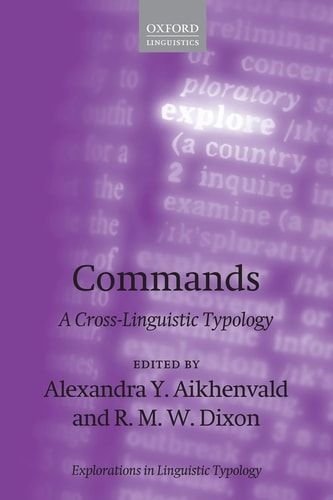
Commands: Explorations in Linguistic Typology
0
0
As an Amazon Associate and affiliate partner, Menrva Books earns from qualifying purchases. Learn more
Author Description
This book focuses on the form and the function of commands--directive speech acts such as pleas, entreaties, and orders--from a typological perspective. A team of internationally-renowned experts in the field examine the interrelationship of these speech acts with cultural stereotypes and practices, as well as their origins and development, especially in the light of language contact.The volume begins with an introduction outlining the marking and the meaning of imperatives and other ways of expressing commands and directives. Each of the chapters that follow offers an in-depth analysis of commands in a particular language. These analyses are cast in terms of 'basic linguistic theory'--a cumulative typological functional framework--and the chapters are arranged and structured in a way that allows useful comparison between them. The languages investigated include Quechua, Japanese, Lao, Aguaruna and Ashaninka Satipo (both from Peru), Dyirbal (from Australia), Zenzontepec Chatino (from Mexico), Nungon, Tayatuk, and Karawari (from Papua New Guinea), Korowai (from West Papua), Wolaitta (from Ethiopia), and Northern Paiute (a native language of the United States).
Menrva's Summary
THE THESIS
This volume investigates the structural and functional diversity of directive speech acts across a wide array of global languages. Editors Alexandra Y. Aikhenvald and R. M. W. Dixon assemble a collection of expert analyses to examine how imperatives, pleas, and orders are encoded grammatically and shaped by cultural context. The work utilizes a 'basic linguistic theory' framework to ensure methodological consistency, allowing for rigorous cross-linguistic comparison of how different societies express command and control.
THE SCOPE MAP
What You Will Find
- Comparative analysis of directive speech acts including imperatives, entreaties, and orders.
- Examination of the influence of cultural stereotypes and language contact on command structures.
- In-depth case studies of diverse languages such as Quechua, Japanese, Lao, and Dyirbal.
- A unified typological functional framework for analyzing grammatical marking and semantic meaning.
THE AUTHORITY PERSPECTIVE
Linguists and researchers frequently cite this volume as a standard reference for the study of directive speech acts within typological linguistics. Experts highlight the consistent application of the editors' functional framework as a model for comparative language research.
Page Count:
352
Publication Date:
2020-01-01
Publisher:
Oxford University Press
ISBN-10:
0198852509
ISBN-13:
9780198852506
Language
Linguistics
Academic
Reference
Community Tags
Similar Books