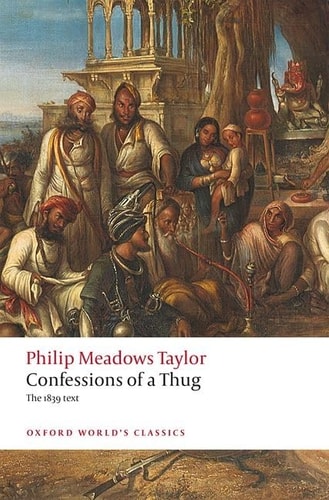
Confessions of a Thug
0
0
As an Amazon Associate and affiliate partner, Menrva Books earns from qualifying purchases. Learn more
Author Description
'You have given a faithful portrait of a Thug's life, his ceremonies, and his acts' Often overshadowed by Kipling's Kim or Forster's A Passage to India, Philip Meadows Taylor's forgotten classic, Confessions of a Thug (1839), is nevertheless the most influential novel of early nineteenth-century British India. This was the first dramatic account to expose a European readership to the fantastic world of the murderous Thugs, or highway robbers, who strangled their victims and who have ever since been a stable of Western popular culture. Writing in the voice of a captured Thug, Taylor presents an Orientalist fantasy that is part picaresque adventure and part colonial exposé. Confessions of a Thug offers a unique glimpse of the colonial world in the making, revealing how the British imagined themselves to be omniscient and in complete control of their Indian subjects. This unique critical edition makes available a fascinating and significant work of Empire writing, in addition to excerpts from the original colonial texts that inspired Taylor's narrative.
Menrva's Summary
THE PULSE
A captured highway robber recounts his life of ritualized murder and deception, forcing the reader to confront the brutal realities of the Thuggee cult in nineteenth-century India. The protagonist, Ameer Ali, serves as the narrator, detailing his initiation into a secret society of stranglers and his subsequent career of crime across the Indian subcontinent. He operates within a rigid hierarchy of criminal tradition, constantly navigating the tension between his loyalty to his brotherhood and the encroaching power of British colonial authority. The narrative framework utilizes a first-person confessional style, blending picaresque adventure with a calculated attempt to justify his actions to his captors.
INSIDE THE PAGES
- First-person confessional narrative structure
- Detailed descriptions of Thuggee rituals and initiation ceremonies
- Exploration of the moral ambiguity inherent in colonial-era criminal accounts
- Picaresque elements detailing travel and survival across the Indian landscape
- Examination of the power dynamics between the British Empire and local subjects
- Use of an unreliable narrator to challenge the reader's perspective
- Vivid depictions of highway robbery and clandestine operations
- Historical context regarding the suppression of the Thuggee cult
THE COLLECTIVE ECHO
Discussion often centers on the novel's role as a foundational text in the genre of colonial literature and its influence on Western perceptions of India. Readers frequently highlight the unsettling nature of the narrator's voice, which oscillates between cold calculation and a strange, distorted sense of honor. Critics often analyze the text as an Orientalist artifact, noting how it reflects the anxieties and self-conceptions of the British administration during the nineteenth century. The pacing is noted for its episodic intensity, which effectively mirrors the unpredictable life of the protagonist. Ultimately, the work remains a significant subject of study for those interested in the intersection of criminal history and imperial narrative construction.
Page Count:
627
Publication Date:
2024-05-01
Publisher:
Oxford University Press
ISBN-10:
0198854641
ISBN-13:
9780198854647
Crime
Adventure
Colonial
Historical
India
English literature
classic
Community Tags
Similar Books