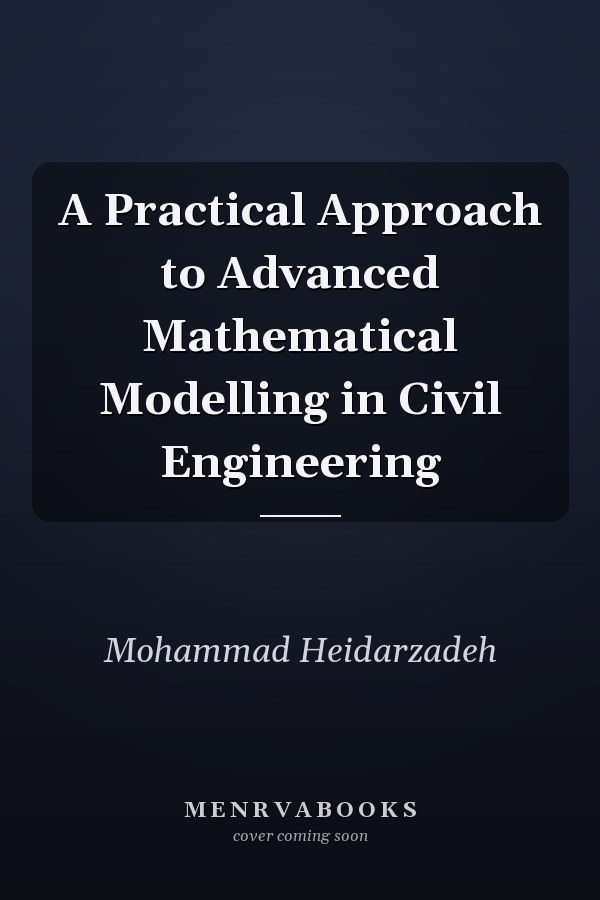
A Practical Approach to Advanced Mathematical Modelling in Civil Engineering
0
0
As an Amazon Associate and affiliate partner, Menrva Books earns from qualifying purchases. Learn more
Author Description
This book revolutionizes the teaching of mathematical modelling in civil engineering schools by systematically addressing numerous real-world engineering challenges, accompanied by Matlab codes for the first time. Commencing with mathematical modeling (chapter 1), it delineates seven steps essential for developing a mathematical model for real-world engineering problems: problem formulation (step 1), outlining the problem and conceptualization (step 2), assumptions (step 3), parametrization and variables (step 4), deriving the equations (step 5), simulations and analysis (step 6), and testing and validation (step 7). Successive chapters apply this methodology to diverse real-world problems across various sub-disciplines of civil engineering, including structural engineering (chapter 2), geotechnical engineering (chapter 3), coastal engineering (chapter 4), water and environmental engineering (chapter 5), and transportation engineering (chapter 6). Appendices A and B provide supplementary materials addressing basic engineering mathematics and Matlab programming, respectively, to assist readers. This book caters to last year undergraduate and post-graduate (MSc and PhD) students in civil engineering and mechanical engineering. It is particularly indispensable for undergraduates and post-graduates in their dissertation work. The inclusion of advanced mathematical models such as machine learning, deep learning, and finite difference methods, along with associated Matlab codes, renders the book highly valuable for practicing engineers in consulting engineering roles.
Menrva's Summary
THE THESIS
This book investigates the systematic application of mathematical modeling to solve complex, real-world challenges within the field of civil engineering. The authors, a team of experienced engineering academics, present a structured seven-step methodology designed to guide students and professionals through problem formulation, conceptualization, and validation. By integrating advanced computational techniques such as machine learning and finite difference methods, the text provides a rigorous framework for bridging theoretical mathematics with practical engineering design.
THE SCOPE MAP
What You Will Find
- A standardized seven-step methodology for developing mathematical models in engineering contexts.
- Practical application chapters covering structural, geotechnical, coastal, environmental, and transportation engineering.
- Integrated MATLAB code examples for each modeled scenario to facilitate computational implementation.
- Supplementary appendices covering foundational engineering mathematics and programming basics.
THE AUTHORITY PERSPECTIVE
Experts highlight this text as a practical resource for advanced students and consulting engineers who require a bridge between theoretical modeling and software implementation. Readers frequently note the utility of the included MATLAB codes for dissertation work and professional project analysis.
Page Count:
384
Publication Date:
2025-06-06
Publisher:
Oxford University Press
ISBN-10:
0198854250
ISBN-13:
9780198854258
Mathematics
Academic
Transportation Engineering
Coastal Engineering
Engineering
Civil Engineering
Structural Engineering
Applied
Geotechnical Engineering
Community Tags
Similar Books