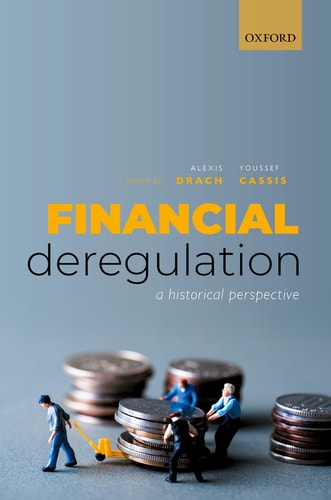
Financial Deregulation: A Historical Perspective
0
0
As an Amazon Associate and affiliate partner, Menrva Books earns from qualifying purchases. Learn more
Author Description
A wave of liberalization swept the developed world at end of the twentieth century. From the 1970s and 1980s onwards, most developed countries have passed various measures to liberalize and modernize the financial markets. Each country had its agenda, but most of them have experienced, to a different extent, a change in regulatory regime. This change, often labeled deregulation and associated with the advent of neoliberalism, was sharply contrasting with the previous era of the Bretton Woods system, which has sometimes been portrayed as an era of financial repression. On the other hand, a quick glance at financial regulation today - at the amount of paper it produces, at its complexity, at the number of people involved, and at the resources invested in it - is enough to say that, somehow, there is more regulation today than ever before. In the new system, financial regulation has taken unprecedented importance. As more archival material is becoming available, a better understanding of the fundamental changes in the regulatory environment towards the end of the twentieth century is now possible. What kind of change exactly was deregulation? Did competition between financial regulators lead to a race to the bottom in regulation? Is deregulation responsible for the recurring financial crises which seem to have characterised the international financial system since the 1980s? The movement towards a more liberal regulatory regime was neither linear nor simple. This book - a collection of chapters studying deregulation in various countries and contexts - examines the national and international pathways of deregulation by providing an in-depth analysis of a short but crucial period in a few major countries.
Menrva's Summary
THE THESIS
This book investigates the nature and consequences of financial deregulation during the late twentieth century, questioning whether the shift from the Bretton Woods system truly resulted in less regulation or merely a transformation of regulatory complexity. The authors, Alexis Drach, Youssef Cassis, and their contributors, utilize newly available archival materials to examine the transition toward neoliberal financial regimes. By analyzing specific national pathways and international contexts, the text argues that the movement toward liberalization was a non-linear process that fundamentally altered the role of financial oversight in the modern era.
THE SCOPE MAP
What You Will Find
- Comparative analysis of regulatory regime changes across multiple major developed nations.
- Historical examination of the transition from the Bretton Woods system to neoliberal financial policies.
- Case studies detailing the national and international pathways of financial liberalization.
- Critical assessment of the relationship between deregulation and the frequency of international financial crises.
THE AUTHORITY PERSPECTIVE
Experts recognize this collection as a significant contribution to the historical study of financial policy, noting its reliance on primary archival sources to challenge common assumptions about the era of deregulation. The text is frequently cited by scholars for its nuanced approach to the complexity of modern regulatory frameworks.
Page Count:
208
Publication Date:
2021-07-15
Publisher:
Oxford University Press
ISBN-10:
0198856954
ISBN-13:
9780198856955
History
Economics
Public Policy
Financial Services Industry
Finance
Neoliberalism
Community Tags
Similar Books