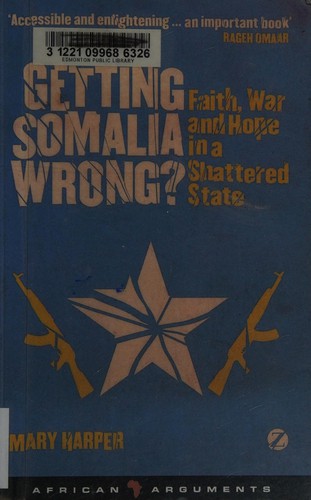
Getting Somalia Wrong?
0
0
As an Amazon Associate and affiliate partner, Menrva Books earns from qualifying purchases. Learn more
Author Description
Somalia is a failed state, representing a threat to itself, its neighbours and the wider world. In recent years, it has become notorious for the piracy off its coast and the rise of Islamic extremism, opening it up as a new 'southern front' in the war on terror. At least that is how it is inevitably portrayed by politicians and in the media. In Getting Somalia Wrong? Mary Harper presents the first comprehensive account of the chaos into which the country has descended and the United States' renewed involvement there. In doing so, Harper argues that viewing Somalia through the prism of al-Qaeda risks further destabilizing the country and the entire Horn of Africa, while also showing that though the country may be a failed state, it is far from being a failed society. In reality, alternative forms of business, justice, education and local politics have survived and even flourished. Provocative in its analysis, Harper shows that until the international community starts to 'get it right' the consequences will be devastating, not just for Somalia, but for the world.--Publisher's website.
Menrva's Summary
THE THESIS
The book challenges the conventional Western portrayal of Somalia as a solely failed state and a security threat. Mary Harper, a seasoned journalist with extensive experience covering Africa, argues that viewing Somalia solely through the lens of terrorism and piracy obscures the resilience and adaptability of its society. The book contends that alternative forms of governance, business, and social structures have not only survived but thrived amidst the chaos, suggesting that international engagement based on a flawed understanding risks further destabilization.
THE SCOPE MAP
- A critical examination of the 'failed state' narrative surrounding Somalia.
- Analysis of the impact of international intervention, particularly from the United States.
- Exploration of alternative societal structures in business, justice, and education.
- Discussion of the geopolitical implications for the Horn of Africa and the wider world.
- An argument for a more nuanced understanding of Somali society and politics.
THE AUTHORITY PERSPECTIVE
The book is regarded as a provocative analysis that challenges prevailing international perceptions of Somalia. By presenting Somalia as a 'failed society' rather than a 'failed state,' Harper offers a counter-narrative to the media and political portrayals that focus on piracy and extremism. The work suggests that a deeper understanding of the country's internal resilience is crucial for effective international engagement, warning that continued misinterpretations could lead to devastating consequences.
Page Count:
217
Publication Date:
2012-01-01
ISBN-10:
1842779338
ISBN-13:
9781842779330
Non-Fiction
Politics
History
International relations
Current Events
Community Tags
Similar Books