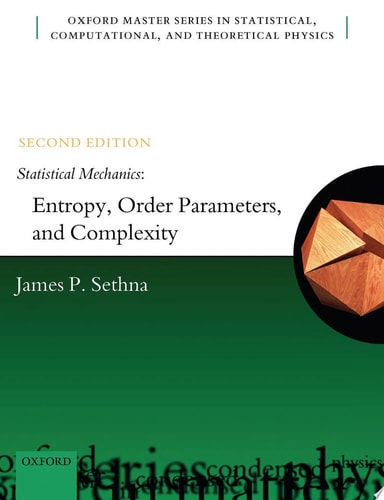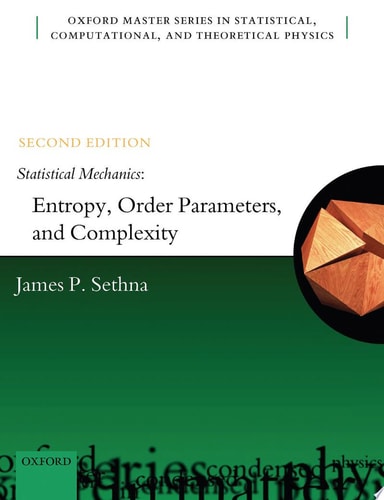
Statistical Mechanics: Entropy, Order Parameters, and Complexity
0
0
As an Amazon Associate and affiliate partner, Menrva Books earns from qualifying purchases. Learn more
Author Description
Statistical mechanics is our tool for deriving the laws that emerge from complex systems. Sethna's text distills the subject to be accessible to those in all realms of science and engineering -- avoiding extensive use of quantum mechanics, thermodynamics, and molecular physics. Statistical mechanics explains how bacteria search for food, and how DNA replication is proof-read in biology; optimizes data compression, and explains transitions in complexity in computer science; explains the onset of chaos, and launched random matrix theory in mathematics; addresses extreme events in engineering; and models pandemics and language usage in the social sciences. Sethna's exercises introduce physicists to these triumphs and a hundred others -- broadening the horizons of scholars both practicing and nascent. Flipped classrooms and remote learning can now rely on 33 pre-class exercises that test reading comprehension (Emergent vs. fundamental; Weirdness in high dimensions; Aging, entropy and DNA), and 70 in-class activities that illuminate and broaden knowledge (Card shuffling; Human correlations; Crackling noises). Science is awash in information, providing ready access to definitions, explanations, and pedagogy. Sethna's text focuses on the tools we use to create new laws, and on the fascinating simple behavior in complex systems that statistical mechanics explains.
Menrva's Summary
THE THESIS
This text investigates how statistical mechanics serves as a foundational tool for deriving emergent laws across diverse scientific and engineering disciplines. James P. Sethna, a professor of physics, presents a pedagogical framework that prioritizes accessibility by minimizing reliance on traditional prerequisites like extensive quantum mechanics or molecular physics. The book argues that the principles of entropy, order parameters, and complexity are universal, providing a unified methodology for modeling phenomena ranging from biological replication to social science trends and computer science data compression.
THE SCOPE MAP
What You Will Find
- Mathematical frameworks for understanding entropy, order parameters, and complexity in complex systems.
- Pedagogical tools including 33 pre-class reading comprehension exercises and 70 in-class activities.
- Interdisciplinary case studies covering biology, computer science, mathematics, engineering, and social sciences.
- Methodologies for modeling emergent behavior in systems such as pandemics, language usage, and random matrix theory.
THE AUTHORITY PERSPECTIVE
Experts and educators frequently cite this work as a versatile resource that successfully bridges the gap between theoretical physics and practical application in other fields. Readers often note the clarity of the prose and the effectiveness of the included exercises in fostering a deeper understanding of complex system dynamics.
Page Count:
496
Publication Date:
2021-03-26
Publisher:
Oxford University Press
ISBN-10:
0198865244
ISBN-13:
9780198865247
Science
Physics
Engineering
Statistical mechanics
Complexity Theory
Mathematics