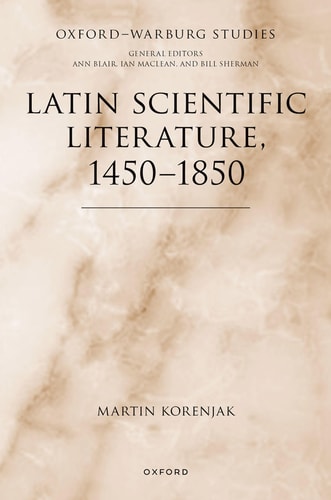
Latin Scientific Literature, 1450-1850
0
0
As an Amazon Associate and affiliate partner, Menrva Books earns from qualifying purchases. Learn more
Author Description
During the early modern period, the emergence of what ultimately became modern science took place mainly in Latin, the international language of educated discourse of the era. Hundreds of thousands of scientific texts were published in Latin from the invention of print around 1450 to the demise of Latin as a language of science around 1850. Despite its importance, our knowledge of this literature is extremely limited. This book aims to provide an overview of this area, the first ever to be written. It does so, not from the perspective of a natural scientist or a historian of science, but of a literary scholar. Instead of the scientific content or methodology of the respective works, it focusses on the genres of scientific literature and their communicative functions. Latin Scientific Literature, 1450-1850 falls into two main parts. The first part ('Contexts') introduces four aspects of early modern intellectual culture which are crucial for an understanding of the scientific literature of the time: the development of science, the role of Latin, the concept of literature, and the rise of print. Part two ('Texts'), offers an overview of Neo-Latin scientific literature. Subsumed under five communicative functions - disclosing sources, presenting facts, arguing for certain positions, summarizing knowledge, and publicizing science - twenty pertinent genres are discussed.
Menrva's Summary
THE THESIS
This book investigates the neglected corpus of scientific literature written in Latin between 1450 and 1850 to understand its role in the development of early modern intellectual culture. Prof. Martin Korenjak, a scholar of classical and Neo-Latin literature, shifts the focus away from the history of scientific discovery toward the literary genres and communicative functions of these texts. By analyzing how these works were structured and presented, the author provides a framework for interpreting the vast, understudied output of Latin scientific writing during the transition to modern science.
THE SCOPE MAP
What You Will Find
- An analysis of the intellectual context including the rise of print and the status of Latin as an international scholarly language.
- A classification of twenty distinct scientific genres categorized by their communicative functions.
- An examination of how authors disclosed sources, presented facts, and argued for specific scientific positions.
- A comprehensive overview of the transition from Latin-based discourse to the modern scientific vernacular.
THE AUTHORITY PERSPECTIVE
Scholars in the fields of Neo-Latin studies and the history of science identify this work as a foundational text for understanding the literary mechanics of early modern scientific communication. Readers frequently note the academic density of the prose and the systematic approach taken to categorize a previously overlooked body of literature.
Page Count:
544
Publication Date:
2024-01-01
Publisher:
Oxford University Press
ISBN-10:
0198866054
ISBN-13:
9780198866053
Science
History
Literary Criticism
Academic
Science
Renaissance
Community Tags
Other Editions(2)
Similar Books