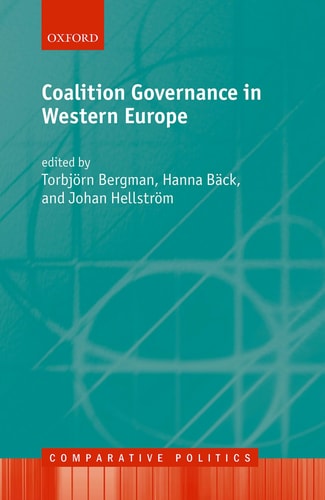
Coalition Governance in Western Europe
0
0
As an Amazon Associate and affiliate partner, Menrva Books earns from qualifying purchases. Learn more
Author Description
Coalition government is the most frequent form of government in Western Europe, but we have relatively little systematic knowledge about how that form of government has developed in recent decades. This book studies such governments, covering the full life-cycle of coalitions from the formation of party alliances before elections to coalition formation after elections (or in the sitting parliament), portfolio distribution among the coalition parties, governing and policy-making when parties work together in office, and the stages that eventually lead to government termination. A particular emphasis is on the study of how coalitions govern together even when they have different agendas. Do individual ministers decide, or the Prime minister or is the outcome a result of a process of coalition compromise? The volume covers 16 West European countries and introduces the case of Croatia, focusing mainly on governments formed during the past two decades.Comparative Politics is a series for researchers, teachers, and students of political science that deals with contemporary government and politics. Global in scope, books in the series are characterised by a stress on comparative analysis and strong methodological rigour. The series is published in association with the European Consortium for Political Research. For more information visit: www.ecprnet.eu.The series is edited by Susan Scarrow, Chair of the Department of Political Science, University of Houston, and Jonathan Slapin, Professor of Political Institutions and European Politics, Department of Political Science, University of Zurich.
Menrva's Summary
THE THESIS
This book investigates the systematic development and operational mechanics of coalition governments within Western European parliamentary systems over the last two decades. The authors, Hanna Bäck, Johan Hellström, and Torbjörn Bergman, utilize a comparative framework to analyze the entire life cycle of coalition governance. By examining how diverse party agendas are reconciled during the formation, policy-making, and termination phases, the text provides a rigorous assessment of how power is distributed and exercised in multi-party cabinets.
THE SCOPE MAP
What You Will Find
- Longitudinal analysis of coalition life cycles from pre-election alliances to government termination.
- Comparative data covering 16 Western European countries plus the case of Croatia.
- Methodological examination of portfolio distribution and ministerial decision-making processes.
- Theoretical framework for understanding coalition compromise and policy-making under differing party agendas.
THE AUTHORITY PERSPECTIVE
Experts identify this volume as a significant contribution to the study of parliamentary institutions and multi-party governance. Readers frequently note the academic density of the prose and the methodological rigor applied to the comparative analysis of European political systems.
Page Count:
784
Publication Date:
2021-10-25
Publisher:
Oxford University Press
ISBN-10:
0198868480
ISBN-13:
9780198868484
Comparative Politics
Public Policy
Government
Community Tags
Similar Books