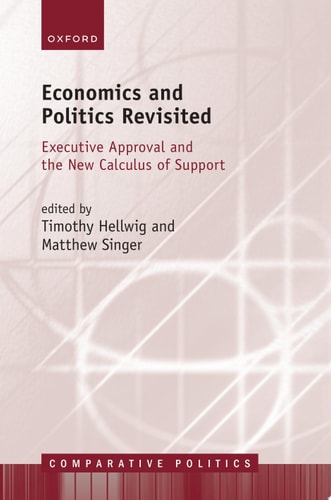
Economics and Politics Revisited: Executive Approval and the New Calculus of Support
0
0
As an Amazon Associate and affiliate partner, Menrva Books earns from qualifying purchases. Learn more
Author Description
What Drives Government Popularity? For Decades, Scholars, Journalists, And Political Pundits Alike Have Converged On A Single Answer: The Economy. A Rising Economy Lifts The Popularity Of The Government, And If The Economy's Fortunes Turn South, So Too Does That Of The Government. This Conventional Wisdom Informs Politicians' Decisions As Well As The Scholarly Commentary On Parties And Elections. Yet The Conditions That Underlie This Model Have Changed In Manycountries As Globalization Has Shifted Control Away From National Policymakers, As Non-economic Cultural Issues Have Risen In Importance, And As Our Politics Have Become More Polarized. At The Same Time, Since The Great Recession In 2008 Persistent Economic Volatility Has Kept The Economy On The Agenda.what, Then, Fuels Government Popularity In Our Current Volatile Environment? Are Political Fortunes Tied To Economic Stability, As In The Past? Or Has The Economy-popularity Link-the Popularity Function-been Severed By A Host Of New And Less Predictable Factors In Post-industrial Societies?to Answer These Questions, Economics And Politics Revisited Uses Data From The Executive Approval Project (eap), A Cross-nationally Comparable Data On Leader Popularity, To Model The Fundamental Dynamics Of Government Support In Advanced Industrial Democracies. Eleven Country-specific Chapters, Each Written By Experts In The Politics Of The Country, Examine The Role Of Economic Performance In Generating Leader Support In Each Country. In All Cases, Chapter Authors Show That Theeconomy Matters For Popularity. However, The Economy-popularity Link Is Stronger In Some Countries Than Others. Further, Chapters Leverage Eap Series To Highlight Change Over Time. Pooled Analyses Extend These Findings, Highlighting How The Public's Responses To The Economy Are Reduced When Political Campaignsshift To Non-economic Issues And When Parties Are Polarization On Non-economic Issues. Collectively, The Volume Highlights How Evolving Issue Agenda
Menrva's Summary
THE THESIS
This book investigates whether the traditional link between economic performance and government popularity remains valid in the context of modern, volatile, and polarized political environments. Authors Timothy Hellwig and Matthew Singer examine how globalization, the rise of non-economic cultural issues, and increased political polarization have altered the calculus of executive approval. By synthesizing data from the Executive Approval Project, the authors provide a framework for understanding how public support for leaders is generated and sustained in contemporary advanced industrial democracies.
THE SCOPE MAP
What You Will Find
- Longitudinal data from the Executive Approval Project (EAP) covering multiple advanced industrial democracies.
- Eleven country-specific case studies authored by regional political experts.
- Pooled statistical analyses comparing the impact of economic performance versus non-economic issue agendas.
Scope Limits
- The analysis is primarily restricted to advanced industrial democracies and does not extensively cover developing economies or non-democratic regimes.
- The study focuses on executive approval rather than broader legislative or institutional trust metrics.
THE AUTHORITY PERSPECTIVE
Experts recognize this volume as a significant update to the classic popularity function models, providing necessary nuance for the post-2008 economic landscape. Readers frequently note the academic density of the prose, which makes it a valuable resource for researchers and students of comparative political behavior.
Page Count:
416
Publication Date:
2023-01-01
Publisher:
Oxford University Press
ISBN-10:
0192871668
ISBN-13:
9780192871664
Economics
Politics
Public Policy
Comparative Politics
Elections & Political Process
Specific Topics
Government
Community Tags
Similar Books







Reader Comments
Share Your Thoughts
No comments yet. Be the first to share your thoughts!