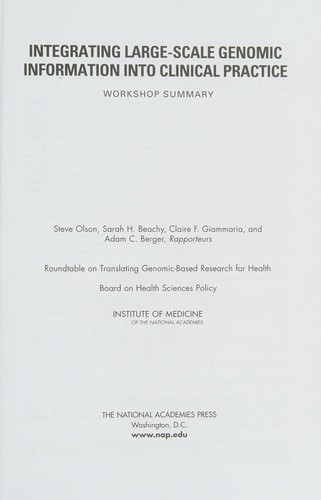
Integrating Large-Scale Genomic Information into Clinical Practice
0
0
As an Amazon Associate and affiliate partner, Menrva Books earns from qualifying purchases. Learn more
Author Description
The initial sequencing of the human genome, carried out by an international group of experts, took 13 years and $2.7 billion to complete. In the decade since that achievement, sequencing technology has evolved at such a rapid pace that today a consumer can have his or her entire genome sequenced by a single company in a matter of days for less than $10,000, though the addition of interpretation may extend this time frame. Given the rapid technological advances, the potential effect on the lives of patients, and the increasing use of genomic information in clinical care, it is important to address how genomics data can be integrated into the clinical setting. Genetic tests are already used to assess the risk of breast and ovarian cancers, to diagnose recessive diseases such as cystic fibrosis, to determine drug dosages based on individual patient metabolism, and to identify therapeutic options for treating lung and breast tumors, melanoma, and leukemia. With these issues in mind and considering the potential impact that genomics information can have on the prevention, diagnosis, and treatment of disease, the Roundtable on Translating Genomic-Based Research for Health hosted a workshop on July 19, 2011, to highlight and identify the challenges and opportunities in integrating large-scale genomic information into clinical practice. Integrating large-scale genomic information into clinical practice summarizes the speaker presentations and the discussions that followed them. This report focuses on several key topics, including the analysis, interpretation, and delivery of genomic information plus workforce, ethical, and legal issues.
Menrva's Summary
THE THESIS
The rapid advancement of genomic sequencing technology presents both immense opportunities and significant challenges for its integration into clinical practice. The report, stemming from a July 2011 workshop, addresses the critical need to bridge the gap between large-scale genomic data and its practical application in patient care. It explores key areas such as the analysis, interpretation, and delivery of genomic information, alongside crucial workforce, ethical, and legal considerations that must be navigated to realize the full potential of genomics in disease prevention, diagnosis, and treatment.
THE SCOPE MAP
- Analysis, interpretation, and delivery of large-scale genomic information.
- Workforce challenges and training needs for healthcare professionals.
- Ethical considerations in the use of genomic data.
- Legal issues related to genomic information and patient privacy.
- The impact of genomics on disease prevention, diagnosis, and treatment.
- The evolution of sequencing technology and its cost implications.
- Examples of current clinical applications of genetic tests.
THE AUTHORITY PERSPECTIVE
This report synthesizes discussions from a workshop focused on integrating genomic information into clinical practice. It highlights the challenges and opportunities presented by rapid technological advances in sequencing. The content addresses critical aspects like data analysis, interpretation, delivery, and the associated workforce, ethical, and legal issues. The publication aims to inform stakeholders on the potential impact of genomics on healthcare.
Page Count:
92
Publication Date:
2012-01-01
ISBN-10:
0309220343
ISBN-13:
9780309220347
Non-Fiction
Science & Technology
Genomics
Bioinformatics
Ethics
Health Policy
Community Tags
Similar Books