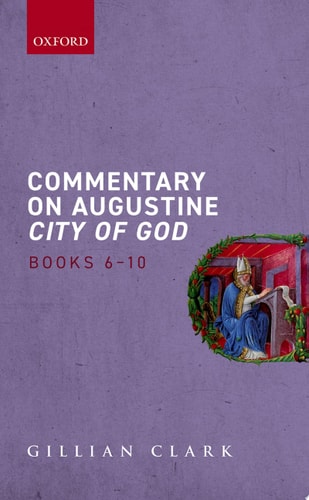
Commentary on Augustine City of God: Books 6-10
0
0
As an Amazon Associate and affiliate partner, Menrva Books earns from qualifying purchases. Learn more
Author Description
This is the second volume in a series of commentaries on Augustine's City of God (De civitate Dei). Books 6-10 are Augustine's answer to those who think that many gods should be worshipped for blessings in the life to come. In Books 1-5 he had replied to those who thought many gods should be worshipped for blessings in this mortal life; he expected this next task to be more challenging, because he must engage with outstanding philosophers who have much in common with Christians. In Books 6-10, he makes the task manageable by selecting very short extracts, all in Latin, from his target authors: on interpretations of Roman myth and cult (books 6-7) the learned Varro, Divine Matters, and Seneca On Superstition; on daimones (Books 8-9) Apuleius, On the God of Socrates, and Asclepius, ascribed to Hermes Trismegistus; on Platonist philosophy (Book 10) translated quotations from Plotinus and Porphyry.Augustine aims to show that the many gods are deceptive demons who want worship for themselves and cannot mediate between mortals and the immortal divine. Especially in Book 10, he contrasts these demons with the good angels who want us to be blessed as they are by worshipping the true God, and with the true mediator Jesus Christ who in his incarnation united humanity with God. Platonist philosophers, Augustine argues, despise the body and aspire to reach the divine by superior intellect; for ordinary people they offer only theurgy, which is dangerous magic. But Christian faith is accessible to all. The coming of Christ and the Church is revealed by the true God in divinely inspired scripture, and Christian worship unites the believer with the self-offering of Christ. Augustine is now ready to move to the second part of City of God, on the origin, course and due ends of the two cities--the city of God and the earthly city--which are intertwined in this world.
Menrva's Summary
THE THESIS
How does Augustine reconcile the intellectual rigor of Platonist philosophy with the necessity of Christian revelation regarding the afterlife? Gillian Clark, a scholar of late antiquity, provides a rigorous analytical framework for examining Augustine's engagement with pagan intellectual traditions. By dissecting the specific arguments Augustine employs against Varro, Seneca, and the Platonists, Clark illustrates how the author constructs a theological defense of the Christian mediator against the perceived deception of daimones.
THE SCOPE MAP
What You Will Find
- Detailed analysis of Augustine's critique of Roman myth, cult practices, and the concept of daimones.
- Examination of Augustine's engagement with primary texts from Varro, Seneca, Apuleius, Plotinus, and Porphyry.
- Comparative study of Platonist intellectualism versus the accessibility of Christian faith and the incarnation.
- Contextual background on the transition from the critique of earthly blessings to the theological focus on eternal salvation.
THE AUTHORITY PERSPECTIVE
Scholars and students of patristic literature frequently cite this commentary as a vital resource for navigating the complex philosophical arguments embedded within Augustine's later books. The text is recognized for its clarity in bridging the gap between classical pagan thought and early Christian polemics.
Page Count:
272
Publication Date:
2024-01-01
Publisher:
Oxford University Press
ISBN-10:
0198870086
ISBN-13:
9780198870081
Politics
History
Religion
Philosophy
History & Schools of Thought
Church History
Church Leadership
Theology
Community Tags
Similar Books