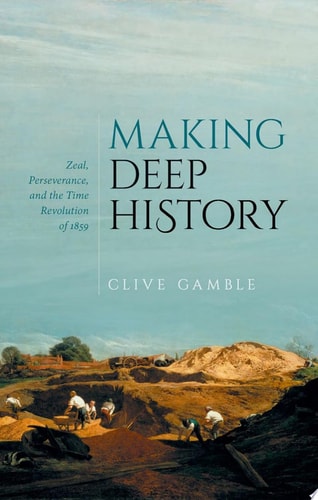
Making Deep History: Zeal, Perseverance, and the Time Revolution of 1859
Author Description
One afternoon in late April 1859 two geologically minded businessmen, John Evans and Joseph Prestwich, found and photographed the proof for great human antiquity. Their evidence -- small, hand-held stone tools found in the gravel quarries of the Somme among the bones of ancient animals -- shattered the timescale of Genesis and kicked open the door for a time revolution in human history.In the space of a calendar year, and at a furious pace, the relationship between humans and time was forever changed. This interpretation of deep human history was shaped by the optimistic decade of the 1850s, the Victorian Heyday in the age of equipoise. Proving great human antiquity depended on matching the principles of geology with the personal values of scientific zeal and perseverance; qualities which time-revolutionaries such as Evans and Prestwich had in abundance. Their revolution was driven by a small group of weekend scientists rather than some great purpose, and it proved effective because of its bonds of friendship stiffened by scientific curiosity and business acumen.Clive Gamble explores the personalities of these time revolutionaries and their scientific co-collaborators and adjudicators -- Darwin, Falconer, Lyell, Huxley, and the French antiquary Boucher de Perthes -- as well as their sisters, wives, and nieces Grace McCall, Civil Prestwich, and Fanny Evans. As with all scientific discoveries getting there was often circuitous and messy; the revolutionaries changed their minds and disagreed with those who should have been allies. Gamble's chronological narrative reveals each step from discovery to presentation, reception, consolidation, and widespread acceptance, and considers the impact of their work on the scientific advances of the next 160 years and on our fascination with the shaping power of time.
Menrva's Summary
THE THESIS
How did the discovery of ancient stone tools in 1859 fundamentally alter the human understanding of deep time and antiquity? Clive Gamble, a specialist in the archaeology of the Paleolithic, examines the convergence of Victorian scientific culture and individual perseverance that enabled this paradigm shift. By analyzing the collaborative efforts of amateur and professional scientists, the author argues that the acceptance of human antiquity was not a singular event but a complex, social, and intellectual process rooted in the specific values of the 1850s.
THE SCOPE MAP
What You Will Find
- A detailed chronological account of the 1859 discoveries in the Somme gravel quarries.
- Analysis of the social networks and personal relationships between key figures like John Evans, Joseph Prestwich, and Charles Darwin.
- Examination of the role of non-professional 'weekend scientists' in advancing geological and archaeological theory.
- Discussion of the broader cultural impact of the time revolution on scientific thought over the subsequent 160 years.
THE AUTHORITY PERSPECTIVE
Scholars and historians of science recognize this work as a meticulous reconstruction of the social history behind a major archaeological breakthrough. Readers frequently note the author's ability to balance technical geological context with the personal narratives of the individuals involved in the discovery.
Page Count:
336
Publication Date:
2021-05-25
Publisher:
Oxford University Press
ISBN-10:
0198870698
ISBN-13:
9780198870692
Biography
Non-Fiction
Science
History
Victorian Era
Archaeology
Scientists
Chronology
Community Tags
Similar Books