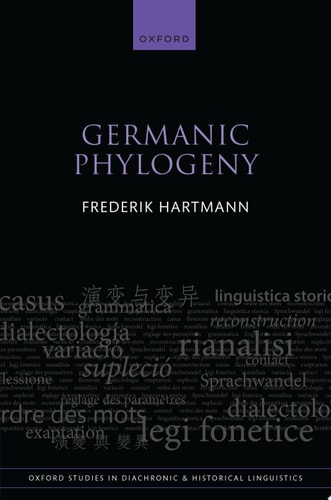
Germanic Phylogeny
0
0
As an Amazon Associate and affiliate partner, Menrva Books earns from qualifying purchases. Learn more
Author Description
This book provides a computational re-evaluation of the genealogical relations between the early Germanic families and of their diversification from their most recent common ancestor, Proto-Germanic. It also proposes a novel computational approach to the problem of linguistic diversification more broadly, using agent-based simulation of speech communities over time. This new method is presented alongside more traditional phylogenetic inference, and the respective results are compared and evaluated. Frederik Hartmann demonstrates that the traditional and novel methods each capture different aspects of this highly complex real-world process; crucially, the new computational approach proposed here offers a new way of investigating the wave-like properties of language relatedness that were previously less accessible. As well as validating the findings of earlier research, the results of this study also generate new insights and shed light on much-debated issues in the field. The conclusion is that the break-up of Germanic should be understood as a gradual disintegration process in which tree-like branching effects are rare.
Menrva's Summary
THE THESIS
This book investigates the genealogical diversification of the Germanic language family by comparing traditional phylogenetic inference with a novel agent-based computational simulation. Frederik Hartmann, a specialist in diachronic linguistics, utilizes these dual methodologies to re-examine the transition from Proto-Germanic to its descendant branches. By modeling speech communities over time, the author argues that the historical development of Germanic languages is better characterized as a gradual disintegration process rather than a simple tree-like branching structure.
THE SCOPE MAP
What You Will Find
- Computational re-evaluation of early Germanic genealogical relations
- Agent-based simulation methodology for modeling speech community evolution
- Comparative analysis of traditional phylogenetic inference versus novel simulation results
- Theoretical framework for understanding wave-like properties in language relatedness
THE AUTHORITY PERSPECTIVE
Experts in the field recognize this work as a significant contribution to the intersection of historical linguistics and computational modeling. Readers frequently note the technical density of the prose, which is intended for advanced students and researchers in diachronic linguistics.
Page Count:
304
Publication Date:
2023-06-30
Publisher:
Oxford University Press
ISBN-10:
0198872739
ISBN-13:
9780198872733
Linguistics
Germanic Languages
Academic
Historical linguistics
Computational linguistics
Community Tags
Similar Books