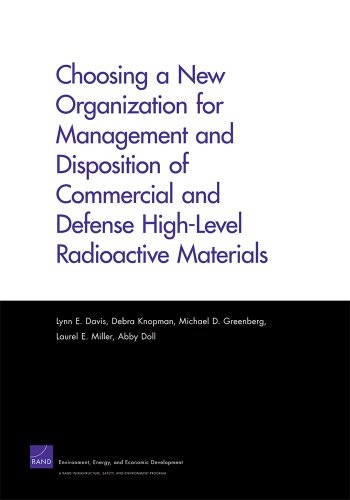
Choosing a new organization for management and disposition of commercial and defense high-level radioactive materials
0
0
As an Amazon Associate and affiliate partner, Menrva Books earns from qualifying purchases. Learn more
Author Description
Finding ways to safely store and ultimately dispose of nuclear waste has been on the national policy agenda for decades and remains a matter of considerable debate. This volume considers the creation of a new, single-purpose organization to manage and dispose of commercial and defense high-level radioactive materials. The authors first examine three organizational models⁰́₄federal government corporation, federally chartered private corporation, and independent government agency⁰́₄and evaluate how well they could perform the goals and responsibilities needed in a new management and disposition organization (MDO). The authors find that a federally chartered private corporation, with its commitment to stockholders and making a profit, would be weak in public accountability and political credibility. For the other two models (a federal government corporation and independent government agency), they describe the critical steps to designing an MDO, focusing on the critical relationship of the organization to the President and Congress, its source of funding, and other organizational attributes, such as how it will engage stakeholders and be treated by federal and state regulatory agencies. The authors emphasize that the key challenge in designing a new MDO is the need to strike a balance between political accountability and flexibility.
Menrva's Summary
THE THESIS
The central problem this book addresses is the safe and effective management and disposal of high-level radioactive materials from both commercial and defense sources. The authors, Lynn E. Davis, examine three distinct organizational models for a new entity tasked with this critical responsibility: a federal government corporation, a federally chartered private corporation, and an independent government agency. The analysis evaluates each model's potential to meet the necessary goals and responsibilities, with a particular focus on public accountability and political credibility. The work details the essential design considerations for a viable organization, including its relationship with the President and Congress, funding mechanisms, and stakeholder engagement strategies.
THE SCOPE MAP
- Analysis of three organizational models: federal government corporation, federally chartered private corporation, and independent government agency.
- Evaluation of each model's suitability for managing and disposing of commercial and defense high-level radioactive materials.
- Discussion of critical design steps for a new Management and Disposition Organization (MDO).
- Examination of the relationship between the MDO, the President, and Congress.
- Consideration of funding sources for the MDO.
- Exploration of stakeholder engagement strategies for the MDO.
- Assessment of how the MDO will interact with federal and state regulatory agencies.
- Emphasis on balancing political accountability with organizational flexibility.
THE AUTHORITY PERSPECTIVE
This volume is presented as a detailed analysis of potential organizational structures for managing nuclear waste, suggesting a focus on the practicalities of governance and policy. The authors' examination of different corporate and agency models indicates a thorough exploration of the strengths and weaknesses inherent in each, particularly concerning public trust and political efficacy. The emphasis on balancing accountability with operational flexibility points to a nuanced approach to a complex, long-standing national challenge. The work appears to be a policy-oriented study aimed at informing decision-makers on the structural requirements for effective radioactive material management.
Page Count:
100
Publication Date:
2012-01-01
ISBN-10:
083307640X
ISBN-13:
9780833076403
Science & Technology
Non-Fiction
Economics
Politics
Community Tags
Similar Books