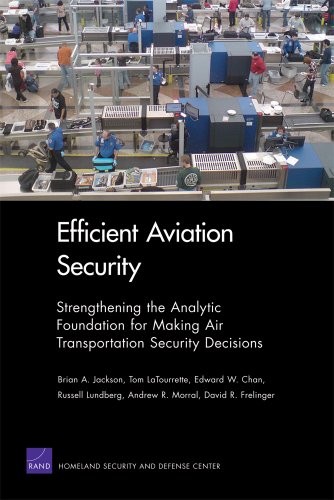
Efficient Aviation Security
0
0
As an Amazon Associate and affiliate partner, Menrva Books earns from qualifying purchases. Learn more
Author Description
Making aviation security more cost-effective is hampered by a lack of understanding of the costs and benefits of security interventions. Moreover, there will always be considerable uncertainty about terrorists{u2019} capabilities and decisionmaking, security system performance, and the tangible and intangible costs of security measures. This volume focuses on exploring ways to use cost-benefit and other types of analysis to improve aviation security decisionmaking in spite of such uncertainties. The authors present a set of analyses that discuss how historical data on aviation security can inform security planning; examine ways to address uncertainty about the costs of security measures; discuss the ways in which different layers of a security system interact; offer a method for incorporating deterrence into the assessment of security measures via the concept of a risk-reduction threshold, using the Federal Air Marshal Service as an example; examine tradeoffs between intended and unintended consequences of security measures, using a trusted traveler program as an example; and discuss the merits of high- versus low-resolution models of aviation terrorism for informing policy. These analyses contribute to filling some of the current gaps in the assessment of the costs, benefits, and efficiency of aviation security measures and strategies.
Menrva's Summary
THE THESIS
This volume explores methods for enhancing aviation security efficiency by addressing the inherent uncertainties in costs, benefits, and threat assessment. The book presents a series of analyses designed to improve decision-making in aviation security, acknowledging the difficulties posed by unknown terrorist capabilities, system performance variations, and the intangible costs of security measures. It examines how historical data can guide security planning, addresses uncertainty in the costs of security interventions, and investigates the interactions between different security layers. The authors also introduce a framework for incorporating deterrence into security assessments and analyze trade-offs between intended and unintended consequences of security programs.
THE SCOPE MAP
- Analysis of historical data to inform aviation security planning.
- Methods for addressing uncertainty in the costs of security measures.
- Examination of the interaction between different layers of a security system.
- Incorporation of deterrence into security assessments using the risk-reduction threshold concept, exemplified by the Federal Air Marshal Service.
- Analysis of trade-offs between intended and unintended consequences of security measures, using a trusted traveler program as a case study.
- Discussion on the merits of high
- versus low-resolution models of aviation terrorism for policy informing.
THE AUTHORITY PERSPECTIVE
The analyses presented in this volume aim to fill existing gaps in the assessment of aviation security measures and strategies. By focusing on cost-benefit analysis and other quantitative methods, the book provides a framework for more informed decision-making in the face of significant uncertainties. The research contributes to a better understanding of the efficiency and effectiveness of various security interventions within the aviation sector. It offers practical insights for policymakers and security professionals seeking to optimize resource allocation and threat mitigation.
Page Count:
182
Publication Date:
2012-01-01
ISBN-10:
0833076523
ISBN-13:
9780833076526
Politics
Economics
Non-Fiction
Security
Transportation
Policy
Community Tags
Similar Books