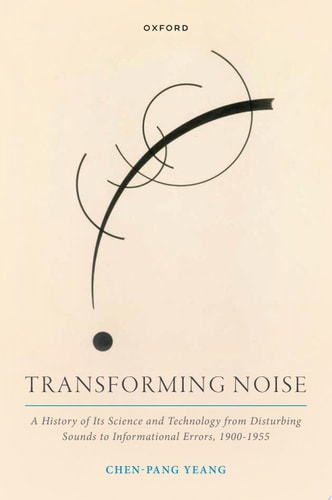
Transforming Noise: A History of Its Science and Technology from Disturbing Sounds to Informational Errors, 1900-1955
0
0
As an Amazon Associate and affiliate partner, Menrva Books earns from qualifying purchases. Learn more
Author Description
Today, the concept of noise is employed to characterize random fluctuations in general. Before the twentieth century, however, noise only meant disturbing sounds. In the 1900s-50s, noise underwent a conceptual transformation from unwanted sounds that needed to be domesticated into a synonym for errors and deviations to be now used as all kinds of signals and information. Transforming Noise examines the historical origin of modern attempts to understand, control, and use noise. Its history sheds light on the interactions between physics, mathematics, mechanical technology, electrical engineering, and information and data sciences in the twentieth century.This book explores the process of engineers and physicists turning noise into an informational concept, starting from the rise of sound reproduction technologies such as the phonograph, telephone, and radio in the 1900s-20s until the theory of Brownian motions for random fluctuations and its application in thermionic tubes of telecommunication systems. These processes produced different theoretical treatments of noise in the 1920s-30s, such as statistical physicists' studies of Brownian fluctuations' temporal evolution, radio engineers' spectral analysis of atmospheric disturbances, and mathematicians' measure-theoretic formulation. Finally, it discusses the period during and after World War II and how researchers have worked on military projects of radar, gunfire control, and secret communications and converted the interwar theoretical studies of noise into tools for statistical detection, estimation, prediction, and information transmission.To physicists, mathematicians, electrical engineers, and computer scientists, this book offers a historical perspective on themes highly relevant in today's science and technology, ranging from Wi-Fi and big data to quantum information and self-organization. This book also appeals to environmental and art historians to modern music scholars as the history of noise constitutes a
Menrva's Summary
THE THESIS
How did the scientific and technological understanding of noise evolve from a nuisance of sound into a foundational concept of information theory between 1900 and 1955? Chen-Pang Yeang, a historian of science and technology, investigates the conceptual shift that occurred as physicists, mathematicians, and engineers moved from domesticating unwanted sounds to utilizing random fluctuations as data. The book utilizes a multidisciplinary framework to trace how theoretical developments in Brownian motion and spectral analysis were synthesized into the statistical tools that underpin modern telecommunications and data science.
THE SCOPE MAP
What You Will Find
- Historical analysis of sound reproduction technologies including the phonograph, telephone, and radio.
- Examination of theoretical treatments of noise from the 1920s and 1930s, including statistical physics and measure-theoretic formulations.
- Case studies on military-funded research during World War II, specifically regarding radar, gunfire control, and secure communications.
- Exploration of the transition from analog sound disturbances to the digital and statistical concepts of error and information.
THE AUTHORITY PERSPECTIVE
Experts identify this work as a rigorous historical examination of the intersection between electrical engineering and statistical physics. Scholars frequently note the academic density of the prose, which provides a comprehensive technical context for the development of modern information theory.
Page Count:
496
Publication Date:
2024-01-01
Publisher:
Oxford University Press
ISBN-10:
0198887760
ISBN-13:
9780198887768
Engineering
Physics
Technology
Mathematics
Technology history
Information Theory
Community Tags
Similar Books




Reader Comments
Share Your Thoughts
No comments yet. Be the first to share your thoughts!