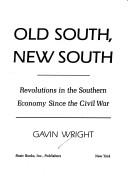
Old South, New South
0
0
As an Amazon Associate and affiliate partner, Menrva Books earns from qualifying purchases. Learn more
Author Description
An original and economically rigorous analysis of the role of slavery in generating economic "backwardness." Wright traces key reasons for the South's century-long status as a second-class country-within-a-country, and assesses the legacy of slavery, the material devastation and social upheaval of the Civil War, and the colonial exploitation of the South by northern capital. He maintains that above all the defining feature of the southern economy was the isolation of its labor market from national and international development. On this basis, Wright explains the sharecropping system, the Populist revolt, the South's limited investment in the education of its own people, and the low-skill, low-productivity, "colonial" character of the region's industrial progress. Only the intervention of the Federal Government during the Great Depression, the author argues, destroyed the bases of the South's low-wage economy, led to long-delayed mechanization of the plantation, helped close the North-South wage gap, and created massive out-migration of unskilled labor during and after World War II. With the demise of the plantation regime, the South opened its doors to outside flows of capital and labor.
Menrva's Summary
THE THESIS
The central question of this book is how slavery and its aftermath shaped the economic backwardness of the American South for over a century. Gavin Wright, an economist, analyzes the persistent economic disadvantages of the South by examining the legacy of slavery, the Civil War's devastation, and the exploitation by northern capital. He argues that the isolation of the South's labor market from national and international development was the defining feature of its economy, leading to systems like sharecropping, limited educational investment, and low-skill industrialization. The book posits that only federal intervention during the Great Depression fundamentally altered this structure, paving the way for modernization and labor migration.
THE SCOPE MAP
- An economically rigorous analysis of the role of slavery in generating regional backwardness.
- An assessment of the legacy of slavery, the Civil War, and the exploitation by northern capital.
- Explanation of the sharecropping system, the Populist revolt, and limited educational investment.
- Analysis of the colonial character of the South's industrial progress.
- The argument for the transformative impact of Federal Government intervention during the Great Depression.
- Discussion of the demise of the plantation regime and the opening of the South to outside capital and labor.
THE AUTHORITY PERSPECTIVE
The book is recognized for its original and economically rigorous analysis of the South's historical economic challenges. Critics have noted Wright's tracing of the key reasons for the South's prolonged status as a 'second-class country-within-a-country.' The work is particularly lauded for its detailed examination of how slavery and its consequences, including the Civil War and external capital exploitation, contributed to the region's economic limitations. The argument that the isolation of the labor market was a defining feature is a central tenet that underpins the explanation of various socio-economic phenomena.
Page Count:
321
Publication Date:
1986-01-01
ISBN-10:
0465051936
ISBN-13:
9780465051939
History
Economics
Non-Fiction
American South
Slavery
Community Tags
Similar Books