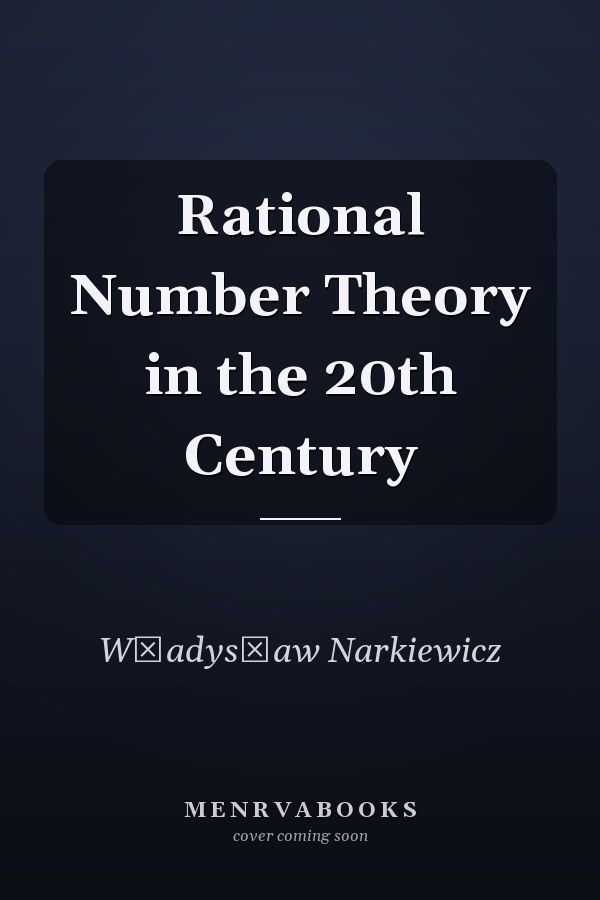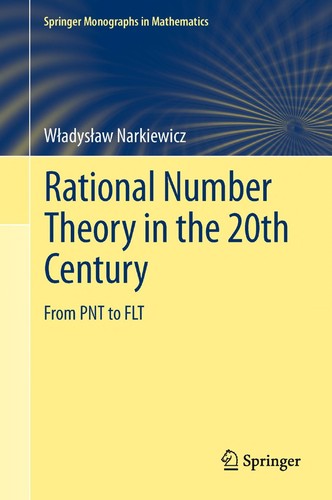
Rational Number Theory in the 20th Century
0
0
As an Amazon Associate and affiliate partner, Menrva Books earns from qualifying purchases. Learn more
Author Description
The last one hundred years have seen many important achievements in the classical part of number theory. After the proof of the Prime Number Theorem in 1896, a quick development of analytical tools led to the invention of various new methods, like Brun's sieve method and the circle method of Hardy, Littlewood and Ramanujan. These methods were the driving force behind new advances in prime and additive number theory. At the same time, Hecke’s resuscitation of modular forms started a whole new body of research which culminated in the solution of Fermat’s problem. Rational Number Theory in the 20th Century: From PNT to FLT offers a short survey of 20th century developments in classical number theory, documenting between the proof of the Prime Number Theorem and the proof of Fermat's Last Theorem. The focus lays upon the part of number theory that deals with properties of integers and rational numbers. Chapters are divided into five time periods, which are then further divided into subject areas. With the introduction of each new topic, developments are followed through to the present day. This book will appeal to graduate researchers and students in number theory, however the presentation of main results without technicalities and proofs will make this accessible to anyone with an interest in the area. Detailed references and a vast bibliography offer an excellent starting point for readers who wish to delve into specific topics.
Menrva's Summary
THE THESIS
The book surveys the significant advancements in rational number theory during the 20th century, a period marked by profound developments following the proof of the Prime Number Theorem and culminating in the solution of Fermat's Last Theorem. The author, Władysław Narkiewicz, a distinguished mathematician, draws upon a century of research to document the evolution of analytical tools and methods such as Brun's sieve and the circle method. These techniques propelled progress in prime and additive number theory, while Hecke's work on modular forms opened new avenues of research. The book meticulously traces these developments, focusing on the properties of integers and rational numbers, and is structured chronologically into five distinct periods.
THE SCOPE MAP
- Developments in number theory from the proof of the Prime Number Theorem (1896) to the proof of Fermat's Last Theorem.
- Focus on the properties of integers and rational numbers.
- Chronological division into five distinct time periods.
- Subject areas further subdivided within each time period.
- Follows developments of new topics through to the present day.
- Accessible presentation of main results without technicalities and proofs.
- Detailed references and a vast bibliography for further study.
THE AUTHORITY PERSPECTIVE
This book is presented as a survey for graduate researchers and students in number theory, but its accessible approach without excessive technicalities aims to engage a broader audience interested in the field. The structure, dividing the century into five chronological periods and further into subject areas, suggests a systematic and comprehensive overview. The inclusion of detailed references and an extensive bibliography indicates its utility as a starting point for deeper exploration into specific topics within rational number theory.
Page Count:
654
Publication Date:
2012-01-01
ISBN-10:
0857295314
ISBN-13:
9780857295316
Non-Fiction
Science
Number Theory
Mathematics