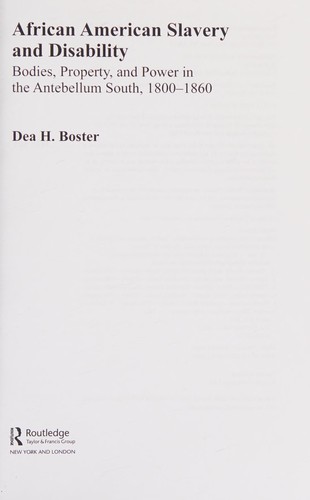
African American Slavery and Disability
0
0
As an Amazon Associate and affiliate partner, Menrva Books earns from qualifying purchases. Learn more
Author Description
Disability is often mentioned in discussions of slave health, mistreatment and abuse, but constructs of how "able" and "disabled" bodies influenced the institution of slavery has gone largely overlooked. This volume uncovers a history of disability in African American slavery from the primary record, analyzing how concepts of race, disability, and power converged in the United States in the first half of the nineteenth century. Slaves with physical and mental impairments often faced unique limitations and conditions in their diagnosis, treatment, and evaluation as property. Slaves with disabilities proved a significant challenge to white authority figures, torn between the desire to categorize them as different or defective and the practical need to incorporate their "disorderly" bodies into daily life. Being physically "unfit" could sometimes allow slaves to escape the limitations of bondage and oppression, and establish a measure of self-control. Furthermore, ideas about and reactions to disability--appearing as social construction, legal definition, medical phenomenon, metaphor, or masquerade--highlighted deep struggles over bodies in bondage in antebellum America.
Menrva's Summary
THE THESIS
This volume investigates the overlooked role of disability within the institution of African American slavery in the antebellum United States. The book analyzes the convergence of race, disability, and power, drawing from primary records to explore how enslaved individuals with physical and mental impairments were diagnosed, treated, and evaluated as property. It examines the complex challenges these individuals posed to white authority, who grappled with categorizing them as defective while needing to integrate their bodies into daily life. The text also considers how physical
THE SCOPE MAP
- Analysis of primary records to uncover the history of disability in African American slavery.
- Exploration of how concepts of race, disability, and power intersected in the first half of the nineteenth century.
- Examination of the unique limitations and conditions faced by slaves with physical and mental impairments.
- Discussion of how enslaved people with disabilities challenged white authority figures.
- Consideration of how physical 'unfitness' could sometimes offer a path to escaping bondage and gaining self-control.
- Highlighting of deep struggles over bodies in bondage through social construction, legal definition, medical phenomenon, metaphor, or masquerade of disability.
THE AUTHORITY PERSPECTIVE
The book offers a novel perspective by focusing on the intersection of disability and slavery, a topic often relegated to footnotes in broader historical discussions. It is likely to be of significant interest to scholars in African American studies, disability studies, and American history, providing a detailed examination of primary sources. The work aims to reframe understandings of enslaved bodies and their agency within the oppressive system of slavery. Its detailed analysis of the antebellum period promises to contribute to ongoing scholarly debates about race, power, and embodiment.
Page Count:
183
Publication Date:
2012-01-01
ISBN-10:
041553724X
ISBN-13:
9780415537247
Non-Fiction
History
Health
Science
19th Century
Slavery
Social History
Community Tags
Similar Books