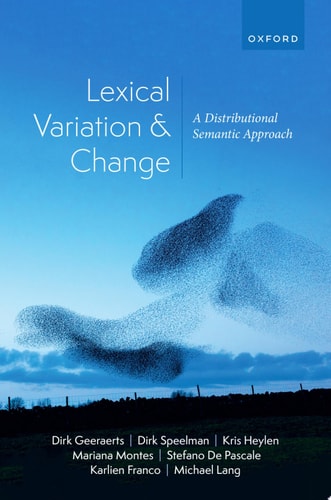
Lexical Variation and Change: A Distributional Semantic Approach
0
0
As an Amazon Associate and affiliate partner, Menrva Books earns from qualifying purchases. Learn more
Author Description
This is an open access title available under the terms of a CC BY-NC-ND 4.0 International licence. It is free to read at Oxford Academic and offered as a free PDF download from OUP and selected open access locations.This book introduces a systematic framework for understanding and investigating lexical variation, using a distributional semantics approach. Distributional semantics embodies the idea that the context in which a word occurs reveals the meaning of that word. In contemporary corpus linguistics, that idea takes shape in various types of quantitative analysis of the corpus contexts in which words appear. In this book, the authors explore how count-based token-level semantic vector spaces, as an advanced form of such a quantitative methodology, can be applied to the study of polysemy, lexical variation, and lectometry. What can distributional models reveal about meaning? How can they be used to analyse the semantic relationship between near-synonyms, and to identify strict synonymy? How can they contribute to the study of lexical variation as a sociolinguistic variable, and to the use of those variables to measure convergence or divergence between language varieties? To answer these questions, the book presents a comprehensive model of lexical and semantic variation, based on the combination of a semasiological, an onomasiological, and a lectal dimension. It explains the mechanism of distributional modelling, both informally and technically, and introduces workflows and corpus linguistic tools that implement a distributional perspective in lexical research. Combining a cognitive linguistic interest in meaning with a sociolinguistic interest in variation, the authors illustrate this distributional methodology using case studies of Dutch and Spanish lexical data that focus on the detection of polysemy, the interaction of semasiological and onomasiological change, and sociolinguistic issues of lexical standardization and pluricentricity.
Menrva's Summary
THE THESIS
This book investigates how distributional semantic models can be systematically applied to analyze lexical variation and semantic change within language. The authors, a team of researchers specializing in cognitive and corpus linguistics, propose a comprehensive framework that integrates semasiological, onomasiological, and lectal dimensions. By utilizing count-based token-level semantic vector spaces, the text provides a rigorous methodology for measuring how word meanings shift across different contexts and social varieties. The work bridges the gap between theoretical cognitive linguistics and quantitative sociolinguistic analysis.
THE SCOPE MAP
What You Will Find
- Quantitative methodologies for analyzing polysemy and near-synonymy using vector spaces.
- A tripartite model of lexical variation incorporating semasiological, onomasiological, and lectal dimensions.
- Case studies applying distributional models to Dutch and Spanish lexical datasets.
- Technical workflows and tools for implementing distributional perspectives in corpus-based research.
THE AUTHORITY PERSPECTIVE
Experts identify this work as a significant contribution to the intersection of computational linguistics and sociolinguistics. Readers frequently note the technical density of the prose, which serves as a specialized resource for researchers and advanced students in the field of corpus-based semantic analysis.
Page Count:
336
Publication Date:
2024-01-01
Publisher:
Oxford University Press
ISBN-10:
0198890672
ISBN-13:
9780198890676
Words Language & Grammar
Computational linguistics
Linguistics
Semantics
Corpus linguistics
Reference
Academic
Community Tags
Similar Books

Reader Comments
Share Your Thoughts
No comments yet. Be the first to share your thoughts!