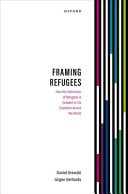
Framing Refugees: How the Admission of Refugees is Debated in Six Countries across the World
0
0
As an Amazon Associate and affiliate partner, Menrva Books earns from qualifying purchases. Learn more
Author Description
Across The World, The Number Of People Forcibly Displaced From Their Homes Has More Than Doubled During The Last Decade. Even Though Under International Law, States Are Not Allowed To Turn Back Refugees, Some Countries Close Their Borders And Push Back Refugees, Others Open Their Borders And Grant Extensive Protection, And Yet Others Admit Some Groups Of Refugees While Excluding Others. How Can We Make Sense Of These Different Responses To Admitting Refugees? This Book Shows That Governments' Refugee Policy, But Also Opposition Parties' Stance On The Issue, Depends Very Much On How They Frame Their Countries' Collective Identity On The One Hand And The Identity And Characteristics Of The Refugees On The Other. By Defining The We And The Others, Politicians Draw On Cultural Repertoires, Which Vary By Country And Political Constituency Within A Country. For Example, Turkey's Open-door Policy Toward Syrian Refugees Under President Erdoğan Becomes Understandable Only If One Takes Into Account How Turkey's National Identity Is Framed With Reference To The Ottoman Empire And Islam. The Restrictive Policy Of The Conservative Polish Government Towards Syrian Refugees Becomes Comprehensible Only If One Takes Into Account The Definition Of Polish Identity With Reference To Christianity And The Fear Of Losing National Sovereignty. The Book Is Based On A Discourse Analysis Of Parliamentary Debates. It Explores The Specific Framing Of Nations' Identities And The Corresponding Perceptions Of Otherness By Focusing On Six Countries That Have Been Confronted With Large Numbers Of Refugees: Germany, Poland, And Turkey, All Responding To The Exodus Of Syrian And Middle Eastern Refugees, Chile's Reaction To The Venezuelan Displacement, Singapore And Its Stance Towards Rohingya Refugees, And Uganda Facing The Displacement From South Sudan. The Study Not Only Looks At Differences Between Governments Of Different Countries But Also Differences Between Political Parties Within Countries--
Menrva's Summary
THE THESIS
This book investigates how national identity and the framing of 'the other' dictate the variance in refugee admission policies across six distinct global nations. The authors, Daniel Drewski and Jürgen Gerhards, utilize a comparative discourse analysis of parliamentary debates to argue that political responses to displacement are not merely economic or logistical, but are deeply rooted in cultural repertoires and collective identity definitions. By examining how governments and opposition parties construct their own national narratives, the study provides a framework for understanding why some states adopt open-door policies while others enforce restrictive border controls.
THE SCOPE MAP
What You Will Find
- Comparative analysis of refugee policy in Germany, Poland, Turkey, Chile, Singapore, and Uganda.
- Discourse analysis methodology applied to parliamentary debates and political rhetoric.
- Examination of how national identity, religion, and historical legacy influence border policy.
- Analysis of the interplay between government stances and opposition party rhetoric regarding displaced populations.
THE AUTHORITY PERSPECTIVE
Experts in political sociology and international relations identify this work as a significant contribution to the study of migration policy and national identity construction. Readers frequently note the academic rigor of the discourse analysis, which provides a clear, evidence-based explanation for the disparate global responses to the refugee crisis.
Page Count:
320
Publication Date:
2024-09-15
Publisher:
Oxford University Press
ISBN-10:
019890472X
ISBN-13:
9780198904724
Politics
Systems Theory
Sociology
Public Policy
International relations
Community Tags
Similar Books




Reader Comments
Share Your Thoughts
No comments yet. Be the first to share your thoughts!