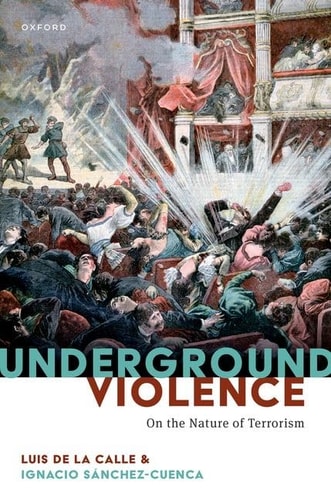
Underground Violence: On the Nature of Terrorism
0
0
As an Amazon Associate and affiliate partner, Menrva Books earns from qualifying purchases. Learn more
Author Description
Why Is Terrorism Such A Slippery Concept? Unlike Other Concepts Employed In Studies Of Conflict, Terrorism Is Particularly Hard To Pin Down. Can Terrorism Be Equated With Civilian Victimization? Is It A Refined Form Of Coercive Violence, Based On The Spread Of Terror? Despite The Endless Terminological Debate, There Is An Underlying Logic In The Way In Which Speak About Terrorism. This Book Is Aimed At Uncovering This Logic, Providing A Systematic, Coherent And Rigorous Conceptualization Of The Phenomenon. Terrorism Is A Unique Form Of Political Violence Due To The Underground Nature Of Its Violence. Unlike Other Forms Of Violence, Underground Political Violence Does Not Require Any Control Of The Territory In Which The Attack Takes Place. The Quintessential Underground Attack Is An Improvised Explosive Device In The Enemy's Terrain. Because Terrorist Attacks Do Not Presuppose Territorial Control, They Tend To Be Ephemeral. Understanding Terrorism As Underground Political Violence Makes Sense Of Many Traits That Are Commonly Associated With The Concept: Its International Dimension, The Possibility Of Lone-actors, And State Terrorism As Covert Operations Abroad. Terrorism Tends To Emerge In Highly Asymmetric Conditions And Is Frequently Used By The Weaker Party (hence The Motto That Terrorism Is The Weapon Of The Weak). Through Large-n Empirical Tests And Case Studies (eta, Tupamaros, Shining Path, Fatah, Isis, And The Palestinian Insurgent Groups), This Book Shows That The Conception Of Terrorism As Underground Political Violence Has Some Organizing Power And Can Be Used In Empirical Analysis To Shed Light On The Determinants And Dynamics Of Terrorism-- Provided By Publisher.
Menrva's Summary
THE THESIS
This book investigates the core question of why terrorism remains a conceptually elusive phenomenon and proposes a systematic framework to define it as a specific form of underground political violence. Authors Luis De la Calle and Ignacio Sánchez-Cuenca, both established scholars in political science and conflict studies, utilize a combination of large-n empirical testing and qualitative case studies to argue that the defining characteristic of terrorism is its lack of territorial control. By shifting the focus from the intent to spread terror to the tactical nature of the violence itself, they provide a rigorous analytical model for understanding the dynamics of asymmetric conflict.
THE SCOPE MAP
What You Will Find
- A conceptual framework defining terrorism as underground political violence rather than civilian victimization.
- Empirical analysis of the relationship between asymmetric power dynamics and the emergence of terrorist tactics.
- Comparative case studies including ETA, Tupamaros, Shining Path, Fatah, and ISIS.
- An examination of the international dimensions, lone-actor phenomena, and state-sponsored covert operations.
THE AUTHORITY PERSPECTIVE
Experts in the field of security studies highlight this work as a significant contribution to the conceptual clarification of political violence. Readers frequently note the academic density of the prose, which serves as a foundational text for those seeking to move beyond terminological debates in terrorism research.
Page Count:
256
Publication Date:
2024-01-01
Publisher:
Oxford University Press
ISBN-10:
0198904819
ISBN-13:
9780198904816
Politics
Specific Topics
Terrorism
Conflict Studies
World politics
Sociology
International relations
Systems Theory
Community Tags
Similar Books