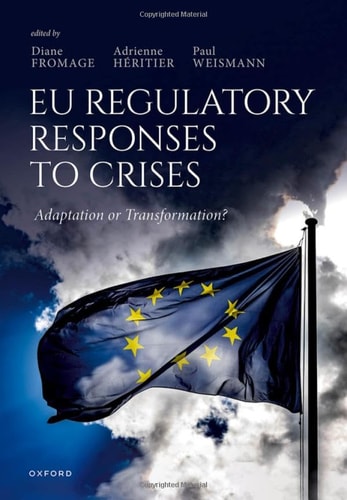
EU Regulatory Responses to Crises: Adaptation or Transformation?
0
0
As an Amazon Associate and affiliate partner, Menrva Books earns from qualifying purchases. Learn more
Author Description
The past years have seen numerous crises from the 2007-2008 financial crisis to the migration crisis and the COVID-19 pandemic. These crises have significantly impacted EU policy in numerous areas including the Economic and Monetary Union, financial regulation and supervision, health policy, state aid control, energy policy, migration policy, and foreign and defence policy. As a result of these crises, EU rule-making has developed in various ways. Some developments have had an institutional dimension in that they concerned the actors involved in rule-making, as exemplified in the introduction of instruction rights of EU bodies vis-à-vis national authorities or the introduction of reverse (qualified) majority voting in the Council. But they also concerned the shape or nature of rules, where we have seen the increasing use of Regulations (as opposed to Directives) and of soft law instead of legally binding rules. The substance of existing rules was also reconsidered, resulting, for instance, in the deviation in practice from the Dublin system as regards the distribution of refugees, in the EU indebting itself on a considerable scale in the wake of the pandemic, and in the boosting of foreign and defence policies as a result of the war in Ukraine.EU Regulatory Responses to Crises examines and compares these developments from a legal and a political science perspective. It analyses the measures taken, successful or not, to save banks, to ensure a fair distribution of migrants across EU Member States, or to support the acquisition of vaccines, for example. This book draws a comprehensive picture of the EU's regulatory toolkit in times of crisis, and its enrichment and refinement in reaction to new challenges.
Menrva's Summary
THE THESIS
This book investigates whether the European Union's regulatory responses to successive crises represent mere adaptation of existing frameworks or a fundamental transformation of its governance structures. The authors, Adrienne Héritier, Diane Fromage, and Paul Weismann, utilize a multidisciplinary approach combining legal analysis and political science to evaluate how the EU has modified its rule-making processes. By examining specific policy shifts from the 2008 financial crisis through the COVID-19 pandemic and the war in Ukraine, the text argues that these crises have necessitated an enrichment and refinement of the EU's regulatory toolkit.
THE SCOPE MAP
What You Will Find
- Analysis of institutional changes including reverse qualified majority voting and instruction rights.
- Comparative study of policy shifts in financial regulation, health, migration, and defense.
- Examination of the transition between hard law, soft law, and the increased use of Regulations.
- Assessment of the EU's fiscal and legislative capacity in response to external shocks.
THE AUTHORITY PERSPECTIVE
Experts identify this work as a rigorous contribution to the study of EU integration and crisis management. Readers frequently note the academic density of the prose, which serves as a valuable resource for scholars and policymakers interested in the evolution of European governance.
Page Count:
240
Publication Date:
2025-04-28
Publisher:
Oxford University Press
ISBN-10:
0198913818
ISBN-13:
9780198913818
Economics
European Union
Public Policy
International relations
Law
Community Tags
Similar Books