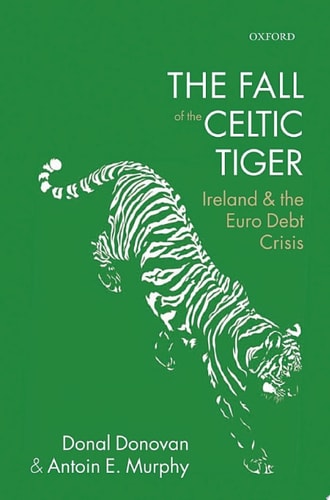
The Fall of the Celtic Tiger: Ireland and the Euro Debt Crisis
0
0
As an Amazon Associate and affiliate partner, Menrva Books earns from qualifying purchases. Learn more
Author Description
By 2000, Ireland had achieved a remarkable macroeconomic performance: 10% economic growth annually, a budget surplus, and a very low debt to GDP ratio. Emigration had disappeared and there was significant immigration from Eastern Europe. Yet, by November 2010, output had collapsed to an extent unprecedented among post war industrial countries, the budget deficit was out of control, and the debt to GDP ratio had soared to around 100%. In an unprecedented development, Ireland was forced to apply for an emergency bail-out package from the Troika (European Commission, European Central Bank, and the International Monetary Fund). This book examines how the Celtic Tiger, a high growth performing economy, fell into a macroeconomic abyss. It is a story that shows how the Irish economy moved from a property market crisis to a banking crisis and fiscal crisis, and how these three crises led to a fourth crisis, the massive financial crisis of 2010. Against the backdrop of the newly created Eurozone, the book demonstrates how a housing boom was transformed into a property market bubble through excessive credit creation. Accompanying the market bubble, buoyant property related taxes enabled a profligate government to over spend and under tax. Few, either in Ireland or Europe, recognised the danger signals because the prevailing economic ideology suggested that financial markets could self-regulate. The book analyses the roles of banks, builders, developers, regulators (the EU, the ECB, the Central Bank of Ireland, and the Irish Financial Regulator), politicians, economists, the media, and a property driven populace during the various stages of the downfall of the Celtic Tiger. It pays particular attention to the decisions to provide a highly controversial comprehensive guarantee for the covered Irish banks in 2008, and the subsequent events that left the government with no alternative but to request the 2010 bail out. Throughout the book, attention is devoted to the allocation of
Menrva's Summary
THE THESIS
This book investigates the systemic failures and economic mechanisms that transformed Ireland from a high-growth economy into a nation requiring an emergency international bail-out. Authors Antoin E. Murphy and Donal Donovan, both possessing extensive backgrounds in economic policy and central banking, utilize historical data and fiscal analysis to map the progression from a property bubble to a full-scale sovereign debt crisis. They argue that a combination of regulatory negligence, excessive credit expansion, and flawed economic ideology created a perfect storm that rendered the Irish state vulnerable to the 2010 financial collapse.
THE SCOPE MAP
What You Will Find
- Analysis of the transition from the Celtic Tiger growth period to the 2010 fiscal collapse.
- Examination of the 2008 bank guarantee and its long-term consequences for the Irish state.
- Evaluation of the roles played by the European Central Bank, the IMF, and domestic Irish regulators.
Scope Limits
- The text focuses primarily on the macroeconomic and institutional failures rather than personal narratives of individual citizens.
- It does not provide a comprehensive history of Irish politics outside the context of the financial and property crises.
THE AUTHORITY PERSPECTIVE
Experts and economists frequently cite this work as a definitive account of the Irish financial crisis due to the authors' deep institutional knowledge. Readers often note the academic density of the prose, which provides a rigorous examination of the regulatory and fiscal decisions that defined the era.
Page Count:
337
Publication Date:
2013-01-01
Publisher:
OUP Oxford
ISBN-10:
0191016047
ISBN-13:
9780191016042
Economics
History
Economics history
Ireland
Debts Public
European Union
Finance
Community Tags
Similar Books

Reader Comments
Share Your Thoughts
No comments yet. Be the first to share your thoughts!