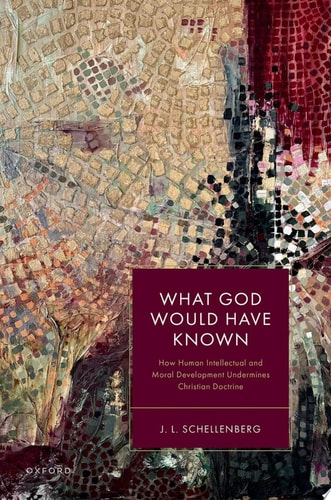
What God Would Have Known: How Human Intellectual and Moral Development Undermines Christian Doctrine
0
0
As an Amazon Associate and affiliate partner, Menrva Books earns from qualifying purchases. Learn more
Author Description
Classical Christian ideas loom large in philosophy of religion today. But arguments against Christian doctrine have been neglected. J. L. Schellenberg's new book remedies this neglect. And it does so in a novel way, by linking facts about human intellectual and moral development to what God would have known at the time of Jesus.The tide of human development, which the early Christians might have expected to corroborate their teaching, has in fact brought many results that run contrary to that teaching. Or at least it will be seen to have done so, says Schellenberg, when we think about the consequences of any God existent then being fully cognizant, when Christian doctrine was first formed, of all that we have laboriously learned since then. Newly discovered facts, not just about such things as evolution and the formation of the New Testament but also about mental illness, violent punishment, the relations between women and men, and the status of same-sex intimacy, suggest detailed new arguments against the content of the Christian revelation--Schellenberg designs and defends twenty--when the prior understanding of the purported revealer is taken into account.Written with Schellenberg's characteristic combination of verve and careful precision, What God Would Have Known offers a thorough and incisive treatment of its subject that remains respectful and fair-minded throughout. It is not concerned with the overworked question of whether classical Christians believe irrationally, but with what overlooked arguments about human development show in relation to the truth or falsity of Christian claims about reality. Fully conversant with relevant developments in science, the book is particularly generous in its attention to recent developments in social and ethical spheres as it works toward its striking conclusion that the God of the Christians, all good and all wise, would not have believed Christian doctrine.
Menrva's Summary
THE THESIS
This work investigates whether the concept of an all-knowing, all-good deity is logically compatible with the historical emergence of Christian doctrine in light of subsequent human intellectual and moral progress. J. L. Schellenberg, a prominent philosopher of religion, utilizes a framework that contrasts the limited knowledge available at the time of the formation of Christian doctrine with the extensive scientific and ethical advancements achieved by humanity since that era. By positing that a divine being would have possessed perfect foresight regarding these developments, the author constructs twenty distinct arguments challenging the truth claims of traditional Christian revelation.
THE SCOPE MAP
What You Will Find
- A systematic analysis of twenty specific arguments against Christian doctrine based on divine foreknowledge.
- Integration of scientific findings, including evolutionary biology and the historical-critical study of the New Testament.
- Examination of social and ethical shifts regarding mental health, gender roles, and human sexuality.
- A philosophical methodology that prioritizes the logical consistency of divine attributes over traditional apologetic debates.
THE AUTHORITY PERSPECTIVE
Experts in the philosophy of religion recognize this text as a rigorous contribution to the debate on divine attributes and the plausibility of religious claims. Readers frequently note the analytical density of the prose, which demands a high level of engagement with both historical theology and contemporary ethical theory.
Page Count:
224
Publication Date:
2024-01-01
Publisher:
Oxford University Press
ISBN-10:
0198912323
ISBN-13:
9780198912323
Religion
Philosophy
Politics
Atheism
Science and Religion
History & Schools of Thought
Christianity
Theology
Ethics
Community Tags
Similar Books