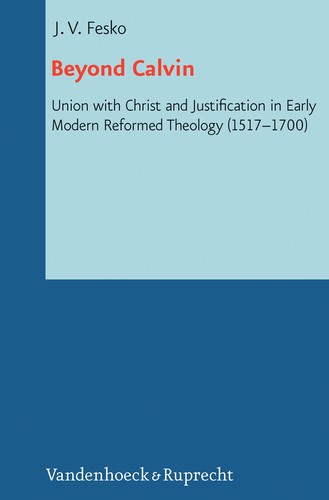
Beyond Calvin
0
0
As an Amazon Associate and affiliate partner, Menrva Books earns from qualifying purchases. Learn more
Author Description
The investigation of union with Christ and justification has been dominated by the figure of John Calvin. Calvin's influence, however, has been exaggerated in our own day. Theologians within the Early Modern Reformed tradition contributed to the development of these doctrines and did not view Calvin as the normative theologian of the tradition. John V. Fesko, therefore, goes beyond Calvin and explores union with Christ and justification in the Reformation, Early Orthodox, and High Orthodox periods of the Reformed tradition and covers lesser known but equally important figures such as Juan de Valdes, Peter Martyr Vermigli, Girolamo Zanchi, William Perkins, John Owen, Francis Turretin, and Herman Witsius. The study also covers theologians that either lie outside or transgress the Reformed tradition, such as Martin Luther, Philip Melanchthon, Faustus Socinus, Jacob Arminius, and Richard Baxter. By treating this diverse body of figures the study reveals areas of agreement and diversity on these two doctrines. The author demonstrates that among the diverse formulations, all surveyed Reformed theologians accord justification priority over sanctification within the broader rubric of union with Christ. Fesko shows that Reformed theologians affirm both union with Christ and the golden chain of salvation, ideas that moderns find incompatible. In sum, rather than reading an individual theologian isolated from his context, this study provides a contextual reading of union with Christ and justification in the Early Modern Reformed context.
Menrva's Summary
THE THESIS
This book challenges the prevailing view that John Calvin's theology exclusively dominated the Reformed tradition concerning union with Christ and justification. J. V. Fesko argues that the influence of Calvin has been overstated and that other theologians within the Early Modern Reformed tradition significantly contributed to the development of these doctrines. The study examines figures from the Reformation, Early Orthodox, and High Orthodox periods, including lesser-known theologians alongside prominent ones, to reveal areas of agreement and diversity. Fesko demonstrates that while formulations varied, Reformed theologians consistently prioritized justification over sanctification within the framework of union with Christ, and affirmed concepts like the golden chain of salvation that modern scholars often find incompatible.
THE SCOPE MAP
- Exploration of union with Christ and justification in the Reformation, Early Orthodox, and High Orthodox periods of the Reformed tradition.
- Analysis of contributions from key figures such as Juan de Valdes, Peter Martyr Vermigli, Girolamo Zanchi, William Perkins, John Owen, Francis Turretin, and Herman Witsius.
- Inclusion of theologians outside or transgressing the Reformed tradition, including Martin Luther, Philip Melanchthon, Faustus Socinus, Jacob Arminius, and Richard Baxter.
- Identification of areas of agreement and diversity on union with Christ and justification across a diverse body of figures.
- Demonstration of the priority of justification over sanctification within the broader rubric of union with Christ among surveyed Reformed theologians.
- Affirmation of the compatibility of union with Christ and the golden chain of salvation, concepts often seen as incompatible by modern scholars.
- Contextual reading of union with Christ and justification within the Early Modern Reformed context, moving beyond isolated individual theologian studies.
THE AUTHORITY PERSPECTIVE
This work is presented as a scholarly examination of theological development within the Reformed tradition. The author's approach aims to provide a contextual reading of key doctrines, moving beyond an overemphasis on John Calvin. The study's scope, encompassing a wide range of historical figures and theological periods, suggests a detailed and comprehensive analysis intended for those with an interest in historical theology and the intricacies of Reformed thought. The publisher's description indicates a focus on demonstrating nuanced agreements and disagreements among theologians on fundamental doctrines.
Page Count:
416
Publication Date:
2012-01-01
ISBN-10:
3525570228
ISBN-13:
9783525570227
Non-Fiction
History
Religion
Theology
Reformation History
Christian Doctrine
Community Tags
Similar Books