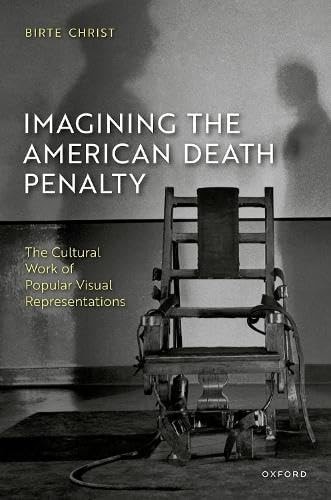
Imagining the American Death Penalty: The Cultural Work of Popular Visual Representations
0
0
As an Amazon Associate and affiliate partner, Menrva Books earns from qualifying purchases. Learn more
Author Description
Imagining the American Death Penalty traces the US American cultural imaginary of capital punishment through popular visual representations from the 1890s to the twenty-first century. The book focuses on three generic and historical clusters of representations: early film from the 1890s through Intolerance (1916), crime film noir of the 1950s and1960s, and legal TV series from the 1990s through the early 2000s. The book makes two central arguments. First, it demonstrates that an increased concern with the death penalty in popular media does not mean that these texts promote an abolitionist agenda: their cultural work is ambiguous at best. This ambiguity is always contingent upon both the affordances of the particular genre and medium in question and on political-legal discursive context. The book explores both in detail. Early film is enchanted with its own representational possibilities due to the progress of technology and, in analogy, with the progress in execution technique, specifically the electric chair. In film noir, genre conventions and the legal back-and-forth before and after Furman predicate ambiguity. In legal TV series, the genre's ensemble casts and its focus on conversational exchange invite open debate. The second argument is that popular visual representations consistently whitewash the death penalty. The book demonstrates that this is the case because the most common narrative around executions in film and TV is to cast the condemned man as a hero who defies the violence of the state, gains dignity by accepting his fate and faults, and in some ways triumphs over death. The American imaginary, until very recently, did or could not imagine Black men to possess that measure of agency that it attributed to its white heroes.
Menrva's Summary
THE THESIS
This work investigates how popular visual media in the United States has shaped the cultural perception of capital punishment from the late nineteenth century to the present. Birte Christ, a scholar in American literature and culture, utilizes a framework of cultural studies to analyze how film and television genres interact with legal discourse. She argues that these representations are fundamentally ambiguous, often failing to advocate for abolition while simultaneously obscuring the racial disparities inherent in the American death penalty system.
THE SCOPE MAP
What You Will Find
- Analysis of early cinema from the 1890s through the 1916 film Intolerance.
- Examination of crime film noir conventions during the 1950s and 1960s.
- Study of legal television series produced between the 1990s and early 2000s.
- Critical assessment of how narrative tropes regarding heroism and agency contribute to the whitewashing of capital punishment.
THE AUTHORITY PERSPECTIVE
Scholars in the field of law and literature identify this text as a rigorous examination of the intersection between media studies and legal history. Readers frequently note the academic density of the prose and the author's precise methodology in deconstructing visual tropes.
Page Count:
336
Publication Date:
2025-08-31
Publisher:
Oxford University Press
ISBN-10:
0198935080
ISBN-13:
9780198935087
History
Film Studies
Sociology
Criminal Law
Law
Media Studies
Community Tags
Similar Books