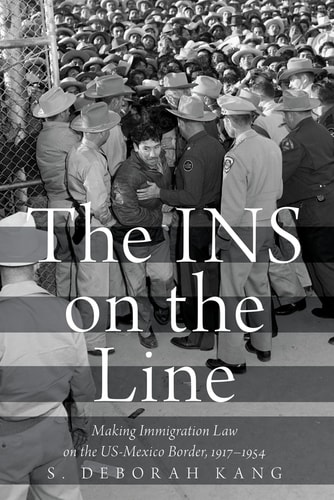
The INS on the Line: Making Immigration Law on the US-Mexico Border, 1917-1954
0
0
As an Amazon Associate and affiliate partner, Menrva Books earns from qualifying purchases. Learn more
Author Description
For much of the twentieth century, Immigration and Naturalization Service (INS) officials recognized that the US-Mexico border region was different. Here, they confronted a set of political, social, and environmental obstacles that prevented them from replicating their achievements on Angel Island and Ellis Island, the most restrictive immigration stations in the nation. In response to these challenges, local INS officials resorted to the law, nullifying, modifying, and creating the nation's immigration laws and policies for the borderlands.In The INS on the Line, S. Deborah Kang traces the ways in which the INS on the US-Mexico border made and remade the nation's immigration laws over the course of the twentieth century. Through a nuanced examination of the agency's legal innovations in the Southwest, Kang demonstrates that the agency defined itself not only as a law enforcement unit but also as a lawmaking body. In this role, the INS responded to the interests of local residents, businesses, politicians, and social organizations on both sides of the US-Mexico border as well as policymakers in Washington, DC. Given the sheer variety of local and federal demands, local immigration officials constructed a complex approach to border control, an approach that closed the line in the name of nativism and national security, opened it for the benefit of transnational economic and social concerns, and redefined it as a vast legal jurisdiction for the policing of undocumented immigrants.The composite approach to border control developed by the INS continues to inform the daily operations of the nation's immigration agencies, American immigration law and policy, and conceptions of the US-Mexico border today.
Menrva's Summary
THE THESIS
How did local Immigration and Naturalization Service (INS) officials on the US-Mexico border transform from mere law enforcement agents into active architects of immigration policy between 1917 and 1954? S. Deborah Kang, a historian specializing in immigration and border law, utilizes archival records and administrative documents to argue that the unique environmental and political pressures of the borderlands forced local officials to bypass federal mandates. By adapting, nullifying, or creating new legal frameworks, these officials established a precedent for border control that balanced local economic interests with national security concerns.
THE SCOPE MAP
What You Will Find
- Historical analysis of INS administrative practices from 1917 to 1954.
- Examination of the tension between federal immigration policy and local borderland realities.
- Case studies illustrating how local officials negotiated with businesses, politicians, and social organizations.
Scope Limits
- The study focuses primarily on the US-Mexico border region and does not provide a comprehensive history of immigration policy at northern US borders or major coastal ports.
THE AUTHORITY PERSPECTIVE
Scholars and historians frequently cite this work as a foundational text for understanding the administrative autonomy of border agencies. Readers often note the academic density of the prose, which provides a rigorous legal and historical framework for contemporary discussions on immigration policy.
Page Count:
296
Publication Date:
2019-08-15
Publisher:
Oxford University Press
ISBN-10:
0190055553
ISBN-13:
9780190055554
History
Politics
Mexico
Professional Career & Trade
Sociology
Americas
Law Enforcement
Administrative Law
Legal History
United States
Specific Topics
World politics
Politics & Government
Criminal Law
American History
New Used & Rental Textbooks
Law
Community Tags
Similar Books