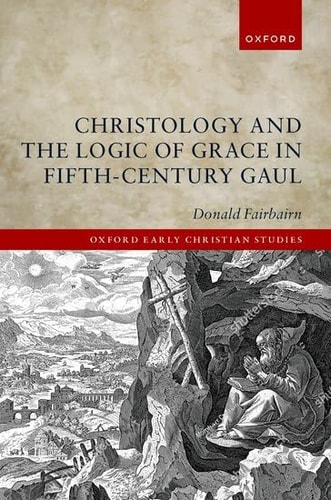
Christology and the Logic of Grace in Fifth-Century Gaul
0
0
As an Amazon Associate and affiliate partner, Menrva Books earns from qualifying purchases. Learn more
Author Description
The monastic writers in fifth-century southern Gaul have long been branded as 'Semi-Pelagians' because of their opposition to Augustine's teaching on predestination and grace. But an overlooked aspect of the grace-related discussions is the role that Christology plays in the articulation of grace, and in fact, the so-called 'Semi-Pelagians' all wrote on Christology in opposition to Nestorianism, as well as writing on grace. Their thinking was sparked at least as much by their opposition to Nestorius as it was by their disagreements with Augustine.This book examines the relation between Christology and grace in the later writings of Augustine, in Leporius both before and after his correction, and in the Gallic writers John Cassian, Vincent of Lérins, Prosper of Aquitaine, and Faustus of Riez. It argues that the Gallic writers hold to a Christology very similar to that of Augustine, a Christology of divine descent in which the incarnate Word is the subject of the human actions and experiences of Christ. Furthermore, the book argues that Augustine and the Gallic writers all affirm the priority of divine grace in salvation, but they differ in the way they establish that priority.Augustine and the Gallic writers reason between Christology and grace with a different logical sequence. Augustine starts with the incapacity of fallen humanity to save itself, then reasons to the predestination of the elect, and then understands the incarnation of the Word in terms of the particular effects on the elect. Predestination thus dominates his understanding of grace and soteriology. In contrast, the Gallic writers (including the later Prosper after he began to move away from Augustine) reason from human incapacity to the incarnation, thus understanding the descent of the Word as holding general effects for all humanity. Only then do they reason to the particular aspects of grace in Christian life. Predestination is thus less central to their thought and can be understood in a differe
Menrva's Summary
THE THESIS
This book investigates the theological connection between Christology and the doctrine of grace within the writings of fifth-century Gallic monastic authors. Donald Fairbairn, a scholar of early Christian history, examines how these writers—often labeled 'Semi-Pelagians'—formulated their views on grace not merely in reaction to Augustine, but through the lens of their opposition to Nestorianism. By comparing the logical sequences used by Augustine and the Gallic writers, Fairbairn argues that their differing soteriological frameworks stem from how they prioritize the incarnation versus predestination.
THE SCOPE MAP
What You Will Find
- A comparative analysis of Christological frameworks in fifth-century Gaul and North Africa.
- An examination of the works of John Cassian, Vincent of Lérins, Prosper of Aquitaine, and Faustus of Riez.
- A study of the impact of the Nestorian controversy on Western understandings of divine grace.
- A methodological breakdown of the logical progression from human incapacity to the necessity of the incarnation.
THE AUTHORITY PERSPECTIVE
Scholars recognize this work as a significant contribution to the study of late antique theology, particularly for its nuanced re-evaluation of the 'Semi-Pelagian' label. Readers frequently note the academic density of the prose, which serves as a rigorous resource for students of patristics and historical theology.
Page Count:
240
Publication Date:
2025-03-19
Publisher:
Oxford University Press
ISBN-10:
0198936192
ISBN-13:
9780198936190
History
Philosophy
Theology
Academic
Christianity
Community Tags
Other Editions(3)
Similar Books



Reader Comments
Share Your Thoughts
No comments yet. Be the first to share your thoughts!