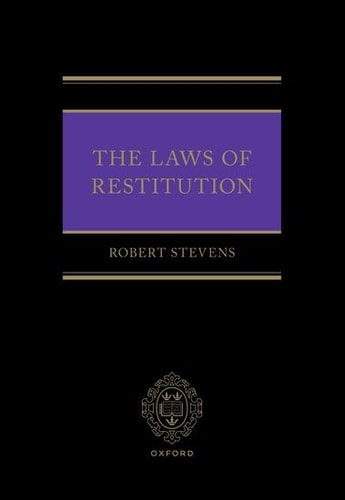
The Laws of Restitution
0
0
As an Amazon Associate and affiliate partner, Menrva Books earns from qualifying purchases. Learn more
Author Description
In The Laws of Restitution, Robert Stevens seeks to show that there is no unified law of restitution or unjust enrichment. This is in contrast to the traditional view of restitution which has long been thought to be reducible to a single "unjust enrichment".The author proposes that there are instead (depending on how you count them) seven or eight different kinds of private law claim, none of which have anything important in common one with another, that have been grouped together by commentators. Few of these claims have anything to do with enrichment, and what is restituted differs between them. Like all private law claims, those gathered here concern (in)justice between individuals, but they have no further unity. Many of them are not based upon an agreement or a wrong, but that negative feature has no utility. As such, Stevens argues that "restitution" or "unjust enrichment" should cease to be discussed as unified areas of law.In this work, Stevens identifies and describes the various reasons for "restitution" that any properly constructed system of private law ought to recognise. He also explains how the law of restitution relates to, and is bound up with, areas of contract, torts, equity, and property law.
Menrva's Summary
THE THESIS
The core question this book investigates is whether the concept of a unified law of restitution or unjust enrichment is a valid legal construct. Robert L. Stevens, a scholar of private law, challenges the traditional academic consensus that restitution can be reduced to a single principle of unjust enrichment. By analyzing the disparate nature of private law claims, he argues that the field is composed of distinct, unrelated categories that have been erroneously grouped together by legal commentators. He posits that these claims should be treated as separate legal entities rather than a cohesive area of law.
THE SCOPE MAP
What You Will Find
- A taxonomy of seven to eight distinct types of private law claims currently mislabeled as restitution.
- An analysis of the intersection between restitution and established fields such as contract, tort, equity, and property law.
- A critical examination of the utility of negative definitions in legal classification.
- A proposed framework for how a properly constructed system of private law should categorize these individual claims.
THE AUTHORITY PERSPECTIVE
Legal scholars and practitioners frequently cite this work as a provocative challenge to the prevailing orthodoxy in restitutionary theory. Experts highlight the text as a significant contribution to jurisprudence that demands a rigorous re-evaluation of how private law is taught and understood in modern legal systems.
Page Count:
496
Publication Date:
2025-05-28
Publisher:
Oxford University Press
ISBN-10:
019894540X
ISBN-13:
9780198945406
Law
Contracts
Legal Theory
Commercial
Jurisprudence
Remedies
Private Law
Restitution
Community Tags
Similar Books