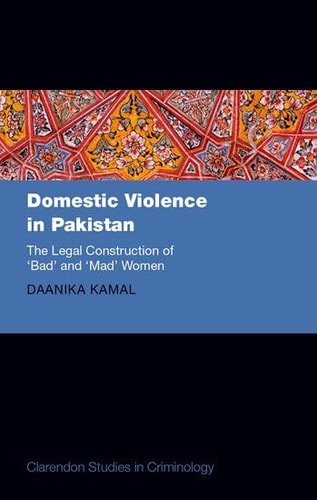
Domestic Violence in Pakistan: The Legal Construction of 'Bad' and 'Mad' Women
0
0
As an Amazon Associate and affiliate partner, Menrva Books earns from qualifying purchases. Learn more
Author Description
This Book Is Based On My Doctoral Thesis, Made Possible By The Funding I Received From Queen Mary University Of London Through The Principal's Research Studentship, And The Academic Support Of A Supervisory Dream Team. Ruth Fletcher Has Been A Phenomenal Mentor, And I Am Hugely Grateful For Her Ongoing Dedication, Curiosity And Guidance. Leila Ullrich And Jeffrey Kennedy Have Continued To Provide Invaluable Encouragement From Near And Far, Keeping Me Optimistic And Motivated Every Step Of The Way. I Am Equally Grateful To My Phd Examiners, Vanessa Munro And Penny Green, For Deeply And Thoroughly Engaging With This Work, And For Providing Feedback That Has Significantly Strengthened Many Parts Of It-- Provided By Publisher.
Menrva's Summary
THE THESIS
This book investigates how the legal system in Pakistan constructs the identities of women who experience domestic violence, specifically examining the labels of 'bad' and 'mad' women. Daanika Kamal, drawing upon her doctoral research at Queen Mary University of London, analyzes the intersection of gender, law, and societal expectations within the Pakistani legal framework. The work argues that legal processes often pathologize or moralize female victims, thereby influencing the outcomes of domestic violence cases and the broader administration of justice.
THE SCOPE MAP
What You Will Find
- Analysis of Pakistani legal statutes regarding domestic violence and family law.
- Examination of the socio-legal construction of female identity in courtroom settings.
- Qualitative research derived from doctoral thesis methodology and academic inquiry.
- Critical evaluation of how judicial discourse categorizes women as either deviant or mentally unstable.
THE AUTHORITY PERSPECTIVE
Experts in the field of criminology and gender studies recognize this work as a rigorous contribution to the understanding of legal systems in South Asia. Readers frequently note the academic density of the prose, which serves as a foundational text for those studying the intersection of law and gender-based violence.
Page Count:
232
Publication Date:
2025-08-22
Publisher:
Oxford University Press
ISBN-10:
0198953445
ISBN-13:
9780198953449
Criminal Law
Systems Theory
Human rights
Law
Sociology
Pakistan
Criminology
Gender Studies
Community Tags
Similar Books