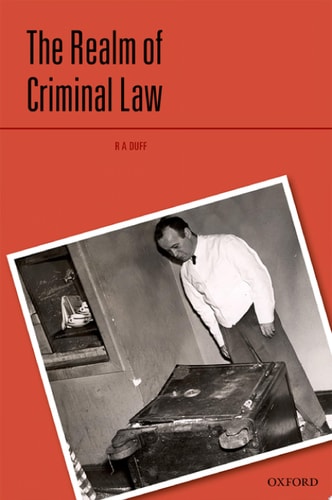
The Realm of Criminal Law
0
0
As an Amazon Associate and affiliate partner, Menrva Books earns from qualifying purchases. Learn more
Author Description
We are said to face a crisis of over-criminalization: our criminal law has become chaotic, unprincipled, and over-expansive. This book proposes a normative theory of criminal law, and of criminalization, that shows how criminal law could be ordered, principled, and restrained. The theory is based on an account of criminal law as a distinctive legal practice that functions to declare and define a set of public wrongs, and to call to formal public account those who commit such wrongs; an account of the role that such practice can play in a democratic republic of free and equal citizens; and an account of the central features of such a political community, and of the way in which it constitutes its public realm-its civil order. Criminal law plays an important, but limited, role in such a political community in protecting, but also partly constituting, its civil order. On the basis of this account, we can see how such a political community will decide what kinds of conduct should be criminalized - not by applying one or more of the substantive master principles that theorists have offered, but by considering which kinds of conduct fall within its public realm (as distinct from the private realms that are not the polity's business), and which kinds of wrong within that realm require this distinctive kind of response (rather than one of the other kinds of available response). The outcome of such a deliberative process will probably be a more limited, and a more rational and principled, criminal law.
Menrva's Summary
THE THESIS
This book investigates the normative foundations of criminalization to address the contemporary crisis of over-criminalization in modern legal systems. R.A. Duff, a prominent legal philosopher, utilizes a framework rooted in democratic theory to argue that criminal law should function as a principled practice of holding citizens accountable for public wrongs. By situating the criminal law within a republic of free and equal citizens, the author proposes a deliberative process for determining the limits of state intervention in both public and private spheres.
THE SCOPE MAP
What You Will Find
- A normative theory of criminalization based on the concept of public wrongs.
- An analysis of the relationship between criminal law and the civil order of a democratic republic.
- A deliberative methodology for distinguishing between conduct that warrants criminal sanction and conduct that remains outside the polity's business.
Scope Limits
- The text does not provide a comprehensive empirical survey of specific criminal codes across different nations.
- It does not offer a singular substantive master principle for criminalization, focusing instead on a procedural and political framework.
THE AUTHORITY PERSPECTIVE
Legal scholars and philosophers frequently cite this work as a foundational text for understanding the normative constraints of the criminal justice system. Readers often note the high level of academic density and the sophisticated philosophical rigor required to engage with the author's arguments.
Page Count:
384
Publication Date:
2018-01-01
Publisher:
OUP Oxford
ISBN-10:
0191058580
ISBN-13:
9780191058585
Criminology
Criminal Law
Jurisprudence
Law
Legal Theory
Political Philosophy
Professional Career & Trade