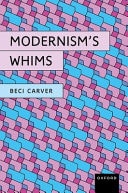
Modernism's Whims
0
0
As an Amazon Associate and affiliate partner, Menrva Books earns from qualifying purchases. Learn more
Author Description
Hatched From The Nonsense Word 'whim-wham' In The Seventeenth Century, 'whim' Began Its Linguistic Life In Obscurity, And Even Having Risen To Prominence In The Nineteenth Century Retained A Furtiveness And Futility, Which It Still Has. To Say That You Act 'on A Whim', Though Not Quite To Admit To A Fault, Is To Acknowledge Your Soft-willed Indulgence Of An Impulse, One Often In Which The Proportion Of Folly Is Riskily High. Thomas Hardy Writes: 'the Lover Of All In The Sun-sweep Is Fool To Whim.' A Whimsical State Of Mind May Call Any Course Of Action Feasible, Any New Romance, Or Equally, Any Mischief. Modernism's Whims Is About Modernism's Ambivalent Relationship With Whims Which, When Indulged, May Endanger The Strongholds Of Its Professional Ethos: Networks, Institutions, Legacies. The Book's Period-specific Argument Is Further Focussed In Chapters On Four Modernist Whimsicians (hardy, T. S. Eliot, William Empson, Elsie Elizabeth Phare), And Backdropped By A Long History Of The Literary Whim, Starting In The Middle Ages With Proto-nonsense And Ending In The Present With A Fatal Reptilian Bark
Menrva's Summary
THE THESIS
This book investigates the ambivalent relationship between Modernist literature and the concept of the 'whim,' exploring how impulsive actions challenge the established professional ethos of the era. Beci Carver examines how the literary whim, historically associated with folly and soft-willed indulgence, serves as a disruptive force within the rigid structures of institutionalized Modernism. By analyzing the tension between creative impulse and professional legacy, the author argues that the whim acts as both a catalyst for artistic innovation and a potential threat to the stability of literary networks.
THE SCOPE MAP
What You Will Find
- A historical survey of the literary whim from medieval proto-nonsense to contemporary manifestations.
- Detailed case studies of four key 'whimsicians': Thomas Hardy, T. S. Eliot, William Empson, and Elsie Elizabeth Phare.
- An examination of the linguistic evolution of the word 'whim' from the seventeenth century to the present.
- A critical framework for understanding how impulsive creative choices interact with institutional legacies and professional reputations.
THE AUTHORITY PERSPECTIVE
Scholars and critics recognize this work as a nuanced contribution to Modernist studies that successfully bridges linguistic history and literary analysis. Readers frequently note the intellectual density of the prose, which provides a rigorous examination of how individual creative impulses navigate the constraints of academic and institutional environments.
Page Count:
0
Publication Date:
2025-01-01
Publisher:
New York : Oxford University Press,
ISBN-10:
0198950721
ISBN-13:
9780198950721
Non-Fiction
Modernism
Literary Criticism
Literary History
Community Tags
Similar Books