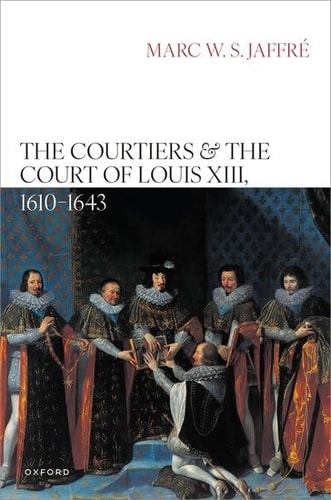
The Courtiers and the Court of Louis XIII, 1610–1643
0
0
As an Amazon Associate and affiliate partner, Menrva Books earns from qualifying purchases. Learn more
Author Description
Louis XIII's court has long been a feature of the popular imaginary, thanks in part to the many movie and TV adaptations of Alexandre Dumas' novel The Three Musketeers. Yet it remains misunderstood, commonly mischaracterised as weak, unimportant, or wholly subservient to the whims of Louis XIII.Seeking to correct this narrative, Marc Jaffré here offers a comprehensive analysis of the court's institutional, political, social, cultural, ceremonial, and financial development, across its very wide range of active participants, from courtiers, financiers, merchants, to lower-ranking household members. The close study engages with the key issues of Louis' reign: the delegitimizing role of Cardinal Richelieu minister-favourite; the turbulent family dynamics that led Louis to wage wars against his mother, his brother, and his cousins; the backdrop of war, both with the Huguenots and within the context of the Thirty Years War; and the transformative rise of salon culture.In so doing, the court is shown to be a central, vibrant, and misunderstood element of early modern and pre-Louis XIV French history and culture. Courtiers, artisans, merchants, and financiers, among others, are shown to have played key roles in shaping the institutional, political, cultural, economic, and military framework of the court, and Louis XIII's reign more generally. In challenging the top-down paradigm prevalent in court studies, this monograph provides crucial correctives to the existing narrative that Louis XIII's court was weak or unimportant and simultaneously revises how early modern courts and their development have been understood historiographically.
Menrva's Summary
THE THESIS
This work investigates the historical significance of the court of Louis XIII, challenging the prevailing academic and popular perception that it was a weak or inconsequential institution. Marc Jaffré utilizes a wide array of archival evidence to reconstruct the court's institutional, political, and social framework. By examining the roles of diverse participants ranging from financiers to household staff, the author argues that the court functioned as a central, vibrant engine of early modern French governance rather than a mere backdrop to the reign of Louis XIV.
THE SCOPE MAP
What You Will Find
- A comprehensive analysis of the court's institutional, financial, and ceremonial development between 1610 and 1643.
- An examination of the influence of Cardinal Richelieu and the impact of the Thirty Years War on court dynamics.
- A detailed study of the rise of salon culture and its role in shaping French social life.
- Evidence derived from a broad spectrum of historical actors, including merchants, artisans, and courtiers, to move beyond a top-down historical paradigm.
THE AUTHORITY PERSPECTIVE
Experts recognize this monograph as a significant revisionist contribution to the historiography of early modern France. Readers frequently note the academic density of the prose and the author's meticulous attention to the complex social hierarchies of the seventeenth-century French court.
Page Count:
368
Publication Date:
2025-07-17
Publisher:
Oxford University Press
ISBN-10:
0198957610
ISBN-13:
9780198957614
Biography
History
Social History
Europe
French History
Political History
European History
Educational Resources
Community Tags
Similar Books