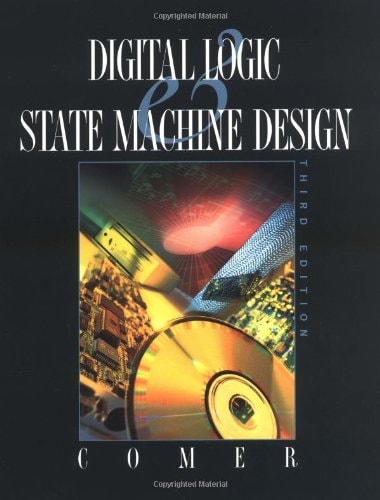
Digital Logic and State Machine Design
0
0
As an Amazon Associate and affiliate partner, Menrva Books earns from qualifying purchases. Learn more
Author Description
From one of the best-known and successful authors in the field comes this new edition of Digital Logic and State Machine Design. The text is concise and practical, and covers the important area of digital system design specifically for undergraduates. Comer's primary goal is to illustrate that sequential circuits can be designed using state machine techniques. These methods apply to sequential circuit design as efficiently as Boolean algebra and Karnaugh mapping methods apply to combinatorial design. After presenting the techniques, Comer proceeds directly into designing digital systems. This task consists of producing the schematic or block diagram of the system based on nothing more than a given set of specifications. The design serves as the basis for the construction of the actual hardware system. In the new Third Edition, Comer introduces state machines earlier than in previous editions, and adds entire chapters on programmable logic devices and computer organization.
Menrva's Summary
THE THESIS
This text investigates the application of state machine techniques as a primary methodology for the efficient design of sequential digital circuits. David J. Comer, an established author in the field of electrical engineering, provides a structured framework for transitioning from abstract system specifications to concrete hardware implementations. The book argues that state machine design offers a superior, more direct approach to sequential logic compared to traditional Boolean algebraic methods.
THE SCOPE MAP
What You Will Find
- Methodologies for sequential circuit design using state machines
- Techniques for translating specifications into schematic block diagrams
- Coverage of programmable logic devices and computer organization
- Integration of combinatorial design principles
Scope Limits
- Does not cover advanced VLSI design or high-level software-based hardware description languages
- Focuses primarily on undergraduate-level foundational concepts rather than industry-grade complex system architecture
THE AUTHORITY PERSPECTIVE
Experts and educators frequently cite this work as a clear, practical resource for students transitioning from basic logic gates to complex system design. Readers often note the text's concise prose and its effective balance between theoretical state machine concepts and applied hardware construction.
Page Count:
592
Publication Date:
1995-06-08
Publisher:
Oxford University Press
ISBN-10:
0030152534
ISBN-13:
9780030152535
Engineering
textbook
Computer Science