
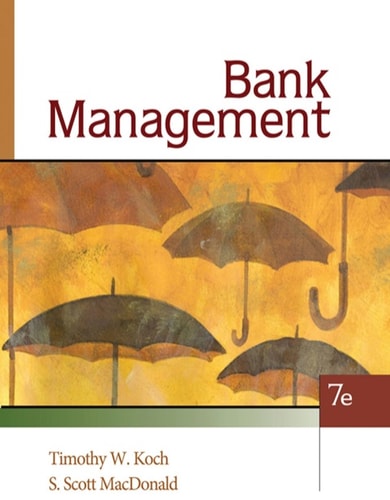
Bank Management
0
0
As an Amazon Associate and affiliate partner, Menrva Books earns from qualifying purchases. Learn more
Author Description
Product Description The management and regulatory environment of commercial banks has seen rapid change in recent years. This modern introduction to commercial bank management is the most current in the market and reflects changes during the last year that competing books do not. Excellent and complete coverage focuses on bank management problems now and in the 21st Century in a way that helps students apply financial concepts to a variety of credit, investment, and funding decisions. Scott MacDonald joins the text as co-author. Review 1. Banking and the Financial Services Industry. Credit Crisis of 2007-2009. Impact on Banks and the Banking Environment. How Do Banks Differ? Trends in the Structure of U.S. Banks. Organizational Structure and Financial Services Business Models. S-Corporation Banks. Financial Services Business Models. Transactions Banking versus Relationship Business Models. Universal Banking. Different Channels for Delivering Banking Services. Branch Banking. Automated Teller Machines. Internet (Online) Banking. Call Centers. Mobile Banking. 2. Government Policies and Regulation. Historical Bank Regulation. Products and Services. Goals and Functions of Depository Institution Regulation. Ensure Safety and Soundness and Provide an Efficient and Competitive System. Supervision and Examination. New Charters. Federal Deposit Insurance. Product Restrictions: Depository Institutions versus Nondepository Institutions. Shortcomings of Restrictive Bank Regulation. Maintaining Monetary Stability and the Integrity of the Payments System. The Role of the Central Bank in the Economy: The Federal Reserve System. Monetary Policy. The Federal Reserve's Crisis Management Tools. The Role of Depository Institutions in the Economy. Efficient and Competitive Financial System. Consumer Protection. Trends in Federal Legislation and Regulation. Key Federal Legislation: 1970-1993. Key Federal Legislation: 1994-2000. Key Federal Legislation: 2001-2006. Key Federal Legislation: 2007-2008. Current Unresolved Regulatory Issues. Capital Adequacy. Regulatory Reform. 3. Analyzing Bank Performance. Commercial Bank Financial Statements. The Balance Sheet. The Income Statement. The Relationship Between the Balance Sheet and Income Statement. The Return on Equity Model. Profitability Analysis. Expense Ratio and Asset Utilization. Managing Risk and Returns. Credit Risk. Liquidity Risk. Market Risk. Operational Risk. Legal and Reputation Risk. Capital or Solvency Risk. Off-Balance Sheet Risk. Evaluating Bank Performance: An Application. Profitability Analysis for PNC in 2007. Risk Analysis for PNC in 2007. PNC's Profitability versus Risk: 2003-2007. Maximizing the Market Value of Bank Equity. Camels Ratings. Performance Characteristics of Banks by Size. Financial Statement Manipulation. Off-Balance Sheet Activities. 4. Managing Noninterest Income and Noninterest Expense. Noninterest Income. Deposit Service Fees. Noninterest Expense. Key Ratios. Which Lines of Business and Customers are Profitable? Line-Of-Business Profitability Analysis. Customer Profitability Analysis. Aggregate Profitability Results from Customer Profitability Analysis. What is the Appropriate Business Mix? Strategies for Managing Noninterest Expense. Cost Management Strategies. Revenue Enhancement. Contribution Growth. 5. The Performance of Nontraditional Banking Companies. The Financial Performance of Goldman Sachs. Goldman Sachs's Income Statement. Goldman Sachs's Balance Sheet. Key Performance Ratios. Risks Faced by Goldman Sachs. Goldman's Risk Profile. The Financial Performance of Mutual of Omaha Bank. Mutual of Omaha Bank's Risk Profile. The Financial Performance of BMW Financial Services and BMW Bank of North America. BMW Bank's Risk Profile. 6. Pricing Fixed-Income Securities. The Mathematics of Interest Rates. Future Value and Present Value: Single Payment. Future Value and Present Value: Multiple Payments. The Relationship Between Interest Rates and Op
Menrva's Summary
THE THESIS
This text investigates the operational, regulatory, and strategic challenges facing commercial banks within the evolving landscape of the 21st-century financial services industry. Authors Timothy W. Koch and Scott MacDonald provide a comprehensive framework for understanding how financial concepts apply to credit, investment, and funding decisions. The book synthesizes historical regulatory data with modern business models to explain the mechanics of bank management in a post-crisis environment.
THE SCOPE MAP
What You Will Find
- Analysis of the 2007-2009 credit crisis and its impact on banking structures
- Comparison of transaction banking versus relationship business models
- Detailed overview of Federal Reserve policies and crisis management tools
- Examination of delivery channels including mobile, online, and branch banking
Scope Limits
- The text focuses primarily on the U.S. banking system and its specific regulatory history
- It does not provide an exhaustive analysis of international banking regulations outside of the U.S. context
THE AUTHORITY PERSPECTIVE
Experts and educators frequently cite this work as a foundational text for students and practitioners seeking to understand the intersection of banking theory and regulatory practice. Readers often note the academic density of the prose, which is balanced by practical applications of financial decision-making.
Page Count:
800
Publication Date:
1995-01-27
Publisher:
South-Western
ISBN-10:
0030152240
ISBN-13:
9780030152245
Business
Economics
textbook
Management
Economics
Banking
Finance
New Used & Rental Textbooks
Community Tags
Other Editions(2)
Similar Books






Reader Comments
Share Your Thoughts
No comments yet. Be the first to share your thoughts!