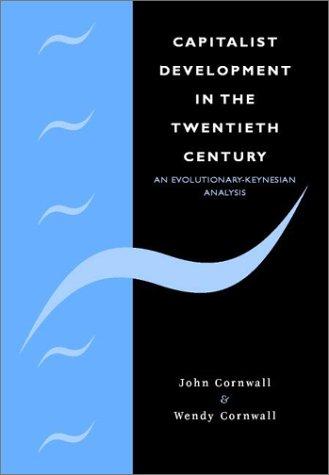
Capitalist Development in the Twentieth Century
0
0
As an Amazon Associate and affiliate partner, Menrva Books earns from qualifying purchases. Learn more
Author Description
Capitalism in the twentieth century has been marked by periods of persistent bad performance alternating with episodes of good performance. Much current economic research ignores this phenomenon; other work concentrates almost exclusively on developing technology as its cause. Cornwall and Cornwall draw upon Schumpeterian, institutional and Keynesian economics to investigate how far these swings in performance can be explained as integral to capitalist development. The authors consider the macroeconomic record of the developed capitalist economies over the past hundred years (including rates of growth, inflation and unemployment) as well as the interaction of economic variables with the changing structural features of the economy in the course of industrialization and transformation. This approach allows for changes both in the economic structure and in the economic variables to be generated within the system. This approach will be essential reading for macroeconomists and economic historians.--Jacket.
Menrva's Summary
THE THESIS
This book investigates the cyclical nature of capitalist economies in the twentieth century, characterized by alternating periods of poor and strong performance. The authors, drawing on Schumpeterian, institutional, and Keynesian economics, explore how these fluctuations are integral to capitalist development, rather than solely attributable to technological advancement. They analyze the macroeconomic records of developed capitalist economies over the past century, examining growth, inflation, and unemployment rates, alongside the interplay between economic variables and evolving structural features during industrialization and transformation. This systemic approach considers how changes in economic structure and variables are generated from within the capitalist system itself.
THE SCOPE MAP
- Analysis of the macroeconomic record of developed capitalist economies over the past hundred years.
- Examination of growth, inflation, and unemployment rates.
- Investigation into the interaction of economic variables with changing structural features.
- Exploration of industrialization and economic transformation.
- Application of Schumpeterian, institutional, and Keynesian economic theories.
- Focus on how economic swings are integral to capitalist development.
- Consideration of how economic structure and variables are generated within the system.
THE AUTHORITY PERSPECTIVE
This book is presented as essential reading for macroeconomists and economic historians, suggesting it offers a rigorous and comprehensive analysis of twentieth-century capitalist development. The approach, which integrates various economic schools of thought and examines both macroeconomic data and structural changes, aims to provide a deeper understanding of the inherent cyclical nature of capitalist economies. The authors' focus on internal systemic generation of economic performance swings is highlighted as a key contribution to the field. The jacket copy indicates a scholarly audience appreciative of detailed economic history and theory.
Page Count:
302
Publication Date:
2001-01-01
ISBN-10:
0521341493
ISBN-13:
9780521341493
Non-Fiction
History
Economics
Business
Economic History
Macroeconomics
Capitalism
Community Tags
Similar Books