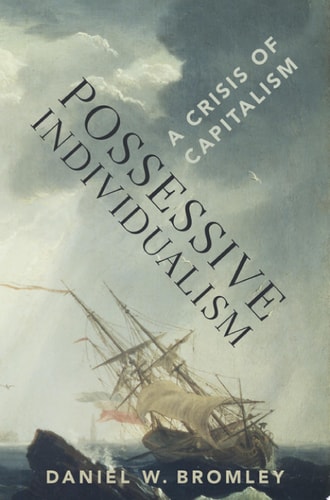
Possessive Individualism: A Crisis of Capitalism
0
0
As an Amazon Associate and affiliate partner, Menrva Books earns from qualifying purchases. Learn more
Author Description
Anxiety and alienation threaten modern democracies. Political anger runs rampant in the United States, Britain voted to leave the European Union, authoritarian governments control several European countries, and millions of desperate migrants are streaming north out of the Middle East, Africa, and Latin America. Many people blame stagnant household incomes and economic inequality. However, Possessive Individualism argues that the origins of world disorder are in the failure of the Enlightenment to anticipate the acquisitive individual as a creature of global capitalism.Daniel Bromley provides a fundamental critique of contemporary capitalism to explain why the world now finds itself in widespread disorder. Capitalism's basic flaw, he argues, is "possessive individualism." Glorification of the rational individual motivated by acquisitiveness prevents the adoption of necessary government programs that would ease the economic burden on beleaguered households. Meanwhile, possessive individualism enables managerial capitalism-controlled by the "one percent"-to suppress wages and salaries, embrace automation, and move jobs overseas. Capitalism is no longer an engine of improved livelihoods and social hope.Drawing on evolutionary institutional economics and political theory this book offers two remedies to the crisis of modern capitalism. Escape from the crisis requires that the isolated acquisitive individual rediscovers a sense of loyalty to others-as neighbors, as colleagues, and as participants in the shared social process of living. Escape also requires that the private firm be reimagined as a public trust in which the economic well-being of employees becomes a central part of its purpose. In the absence of these dual transformations, capitalism as we know it cannot endure.
Menrva's Summary
THE THESIS
This book investigates whether the core tenets of possessive individualism, rooted in Enlightenment philosophy, are the primary drivers of contemporary global political and economic instability. Daniel W. Bromley, an expert in institutional economics, utilizes a framework of evolutionary institutional theory to critique the current trajectory of global capitalism. He argues that the prioritization of the acquisitive individual has eroded social cohesion and prevented the implementation of necessary public policies, ultimately destabilizing democratic institutions.
THE SCOPE MAP
What You Will Find
- Analysis of the historical failure of Enlightenment thought to account for modern acquisitive behavior.
- Critique of managerial capitalism and its impact on wage suppression and labor displacement.
- Proposed remedies involving the restoration of social loyalty and the restructuring of private firms as public trusts.
Scope Limits
- The text does not provide a comprehensive history of all global economic systems.
- The analysis focuses primarily on Western democratic contexts rather than providing a global comparative study of all economic models.
THE AUTHORITY PERSPECTIVE
Scholars and readers often note the academic rigor of Bromley's synthesis of political theory and institutional economics. Experts frequently highlight this work as a significant contribution to the ongoing discourse regarding the structural flaws of modern capitalist systems.
Page Count:
308
Publication Date:
2019-11-11
Publisher:
Oxford University Press
ISBN-10:
0190062843
ISBN-13:
9780190062842
Economics
Economic History
New Used & Rental Textbooks
Education & Reference
Economics
Theory
Social Theory
Capitalism
Macroeconomic Theory
Economics history
Community Tags
Similar Books