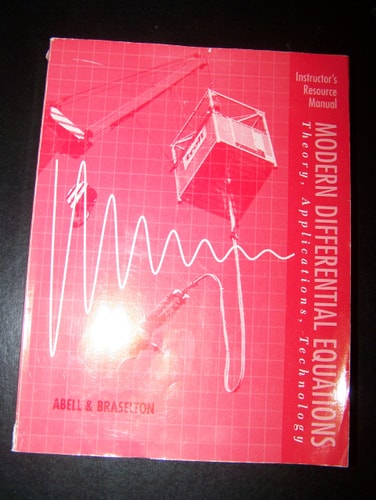
Modern Differential Equations
0
0
As an Amazon Associate and affiliate partner, Menrva Books earns from qualifying purchases. Learn more
Author Description
This introductory differential equations book is one of the first to integrate technology throughout the text. Using a computer algebra system (CAS) helps students to solve problems (both specific and general cases), to reason spatially through visualization, to compare changing variables and parameters, to make inferences, and to evaluate outcomes. Students learn how and when to use technology tools by examples, in exercises, and in applications. The authors' writing style is easy to read, yet mathematically precise. The text assumes students have completed a first-year calculus course and theorems are proved only if their proofs are instructive or have teaching value.
Menrva's Summary
THE THESIS
This text investigates how the integration of computer algebra systems (CAS) can enhance the learning and application of differential equations for undergraduate students. The authors, Braselton et al., present a pedagogical framework that balances traditional mathematical rigor with modern computational tools. By utilizing technology to visualize variables and parameters, the text aims to improve student reasoning and problem-solving capabilities beyond manual calculation.
THE SCOPE MAP
What You Will Find
- Integration of computer algebra systems (CAS) into problem-solving workflows
- Visualization techniques for changing variables and parameters
- Application-based exercises requiring technological proficiency
- Mathematical proofs included only when they offer specific instructional value
Scope Limits
- Assumes prior completion of a first-year calculus course
- Does not provide exhaustive theoretical proofs for all theorems
THE AUTHORITY PERSPECTIVE
Educators frequently note the text's success in bridging the gap between abstract theory and practical computational application. Experts highlight this as a foundational resource for students transitioning from calculus to more advanced engineering and physics mathematics.
Page Count:
0
Publication Date:
1995-10-01
Publisher:
Brooks/Cole
ISBN-10:
0030161991
ISBN-13:
9780030161995
Technology
Education
Calculus
Mathematics
Community Tags
Similar Books