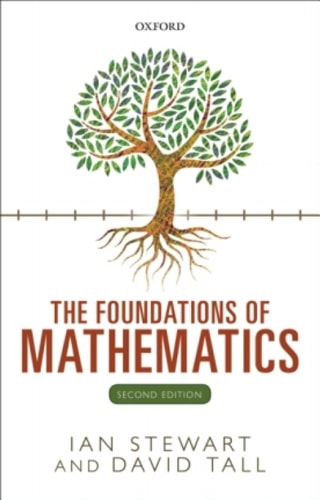
The Foundations of Mathematics
0
0
As an Amazon Associate and affiliate partner, Menrva Books earns from qualifying purchases. Learn more
Author Description
The transition from school mathematics to university mathematics is seldom straightforward. Students are faced with a disconnect between the algorithmic and informal attitude to mathematics at school, versus a new emphasis on proof, based on logic, and a more abstract development of general concepts, based on set theory. The authors have many years' experience of the potential difficulties involved, through teaching first-year undergraduates and researching the ways in which students and mathematicians think. The book explains the motivation behind abstract foundational material based on students' experiences of school mathematics, and explicitly suggests ways students can make sense of formal ideas. This second edition takes a significant step forward by not only making the transition from intuitive to formal methods, but also by reversing the process- using structure theorems to prove that formal systems have visual and symbolic interpretations that enhance mathematical thinking. This is exemplified by a new chapter on the theory of groups. While the first edition extended counting to infinite cardinal numbers, the second also extends the real numbers rigorously to larger ordered fields. This links intuitive ideas in calculus to the formal epsilon-delta methods of analysis. The approach here is not the conventional one of 'nonstandard analysis', but a simpler, graphically based treatment which makes the notion of an infinitesimal natural and straightforward. This allows a further vision of the wider world of mathematical thinking in which formal definitions and proof lead to amazing new ways of defining, proving, visualising and symbolising mathematics beyond previous expectations.
Menrva's Summary
THE THESIS
This book investigates the cognitive and conceptual transition from informal, algorithmic school mathematics to the rigorous, proof-based framework of university-level mathematics. The authors, David Tall and Ian Stewart, utilize their extensive experience in undergraduate instruction and mathematical cognition research to bridge the gap between intuitive understanding and formal abstraction. By employing structure theorems and visual interpretations, they provide a pedagogical framework that allows students to anchor formal definitions in familiar symbolic and graphical contexts.
THE SCOPE MAP
What You Will Find
- A pedagogical bridge between school-level calculus and formal epsilon-delta analysis.
- An introduction to set theory and the logic of mathematical proof.
- A treatment of infinite cardinal numbers and ordered fields.
- A graphical approach to infinitesimals as an alternative to nonstandard analysis.
- A dedicated chapter on the theory of groups.
Scope Limits
- The text does not serve as a comprehensive encyclopedia of all mathematical foundations.
- It does not focus on advanced research-level topology or complex analysis beyond the introductory transition.
THE AUTHORITY PERSPECTIVE
Educators and students frequently identify this text as a bridge for first-year undergraduates struggling with the shift toward abstraction. Experts highlight the authors' focus on cognitive development as a distinct and effective pedagogical approach to foundational mathematics.
Page Count:
412
Publication Date:
2015-01-01
Publisher:
OUP Oxford
ISBN-10:
0191016470
ISBN-13:
9780191016479
Mathematics
Calculus
Logic
Mathematics - General
Set Theory
Education
Mathematics Statistics