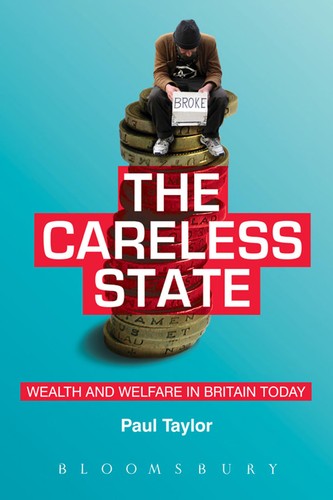
The Careless State
0
0
As an Amazon Associate and affiliate partner, Menrva Books earns from qualifying purchases. Learn more
Author Description
This book considers the social and economic damage wrought by neo-liberalism, in Britain and beyond. Paul Taylor analyses the effects of the increasing inequalities of income and wealth in recent years, concluding that a wide range of problems for the middle sections of society can be traced to the appearance of a class of the ' ber-rich', the example they set and the demands they make. He takes the view that what has happened is the opposite of the much vaunted 'trickle-down effect'; there is actually a 'trickle-up effect' not only in the distribution of wealth but also in the ownership of property and access to education, medicine and the law. He goes on to look at the government's failure to deal effectively with these problems, putting them in the context of the need to deal with the threat of terrorism and the effects of globalization. The book is highly relevant to the current crisis in the global financial system, especially with regard to its effects in the UK and USA, but it places that crisis in the context of wider developments.--Bloomsbury Publishing.
Menrva's Summary
THE THESIS
The book investigates the detrimental social and economic consequences of neo-liberal policies, particularly focusing on Britain. Paul Taylor, drawing on his expertise, analyzes the escalating inequalities in income and wealth, arguing that the rise of the 'super-rich' creates a 'trickle-up effect' rather than the promised 'trickle-down.' This phenomenon impacts property ownership, education, healthcare, and legal access, disproportionately affecting the middle strata of society. The analysis further contextualizes these domestic issues against the backdrop of global terrorism threats and the broader forces of globalization, offering a perspective highly relevant to the global financial crisis of the time.
THE SCOPE MAP
- Analysis of the social and economic damage caused by neo-liberalism.
- Examination of increasing income and wealth inequalities.
- The concept of a 'trickle-up effect' versus 'trickle-down.'
- Impacts on property ownership, education, medicine, and law.
- Government's failure to address these issues effectively.
- Contextualization within the threats of terrorism and globalization.
- Relevance to the global financial crisis, with a focus on the UK and USA.
THE AUTHORITY PERSPECTIVE
The book is positioned as a critical examination of neo-liberalism's impact, particularly relevant to the global financial crisis of its publication year. Its analysis of wealth distribution and government response suggests a focus on systemic issues and their societal consequences. The author's perspective on the 'trickle-up effect' offers a counterpoint to conventional economic theories. The book aims to provide a comprehensive understanding of how economic policies shape social structures and access to essential services.
Page Count:
230
Publication Date:
2010-01-01
ISBN-10:
1849660018
ISBN-13:
9781849660013
Non-Fiction
Economics
Politics
Social Science
Community Tags
Similar Books