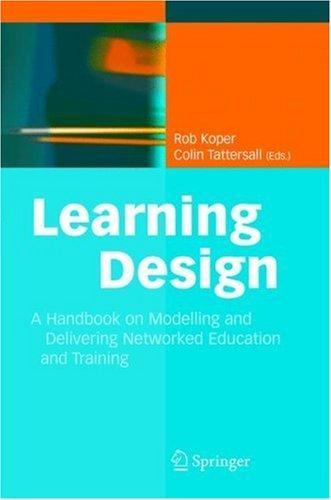
Learning Design
0
0
As an Amazon Associate and affiliate partner, Menrva Books earns from qualifying purchases. Learn more
Author Description
E-learning is still in its infancy. This can be seen both in the limited pedagogical quality and lack of portability of e-learning content, and in the lack of user-friendly tools to exploit the opportunities offered by current technologies. To be successful, e-learning must offer effective and attractive courses and programmes to learners, while at the same time providing a pleasant and effective work environment for staff members who have the task to develop course materials, plan the learning processes, provide tutoring, and assess performance. To overcome these deficiencies, the IMS Global Learning Consortium Inc. released the Learning Design Specification in 2003. With Learning Design it is possible to develop and present advanced, interoperable e-learning courses embracing educational role and game playing methods, problem-based learning, learning community approaches, adaptivity and peer coaching and assessment methods. In this handbook Koper and Tattersall have put together contributions from members of the "Valkenburg Group", consisting of 33 experts deeply involved in e-learning and more specifically learning design. The result is a rich and lasting source of information for both e-learning course and tool developers, providing information about the specification itself, how to implement it in practice, what tools to use, and what pitfalls to avoid. The book not only reports first experiences, but also goes beyond the current state of the art by looking at future prospects and emerging applications.
Menrva's Summary
THE THESIS
The book addresses the nascent state of e-learning and proposes the Learning Design Specification as a solution to its pedagogical and technological limitations. Koper and Tattersall compile contributions from 33 experts in the field to create a comprehensive handbook on implementing this specification. The work aims to guide developers in creating effective, interoperable e-learning courses that incorporate advanced pedagogical methods and tools, while also highlighting practical implementation strategies and potential challenges.
THE SCOPE MAP
- Detailed explanation of the IMS Global Learning Consortium's Learning Design Specification.
- Guidance on developing and presenting advanced, interoperable e-learning courses.
- Exploration of educational role-playing, problem-based learning, and learning community approaches.
- Discussion of adaptivity, peer coaching, and assessment methods in e-learning.
- Insights into practical implementation, tool selection, and pitfalls to avoid.
- First-hand experiences and future prospects in e-learning development.
THE AUTHORITY PERSPECTIVE
This handbook is positioned as a foundational text for e-learning and learning design professionals, offering practical guidance and theoretical underpinnings for the Learning Design Specification. Its compilation of expert contributions suggests a comprehensive overview of the state of the art in 2005, aiming to bridge the gap between technological potential and pedagogical quality in online education. The work is intended for course developers, tool creators, and educators seeking to enhance the effectiveness and attractiveness of e-learning environments.
Page Count:
412
Publication Date:
2005-01-01
ISBN-10:
3540228144
ISBN-13:
9783540228141
Science
Science & Technology
Action
Non-Fiction
Pedagogy
E-Learning
Educational Technology
Learning Management Systems
Instructional Design
Community Tags
Similar Books