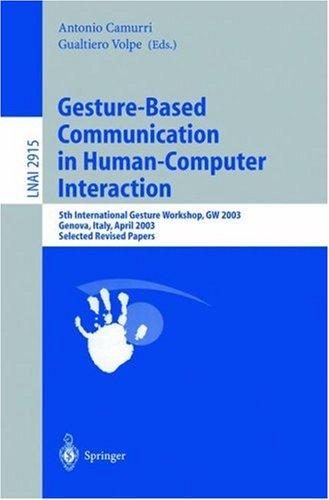
Gesture-based Communication in Human-Computer Interaction
0
0
As an Amazon Associate and affiliate partner, Menrva Books earns from qualifying purchases. Learn more
Author Description
Research on the multifaceted aspects of modeling, analysis, and synthesis of - man gesture is receiving growing interest from both the academic and industrial communities. On one hand, recent scienti?c developments on cognition, on - fect/emotion, on multimodal interfaces, and on multimedia have opened new perspectives on the integration of more sophisticated models of gesture in c- puterystems.Ontheotherhand,theconsolidationofnewtechnologiesenabling “disappearing” computers and (multimodal) interfaces to be integrated into the natural environments of users are making it realistic to consider tackling the complex meaning and subtleties of human gesture in multimedia systems, - abling a deeper, user-centered, enhanced physical participation and experience in the human-machine interaction process. The research programs supported by the European Commission and s- eral national institutions and governments individuated in recent years strategic?elds strictly concerned with gesture research. For example, the DG Infor- tion Society of the European Commission (www.cordis.lu/ist) supports several initiatives, such as the “Disappearing Computer” and “Presence” EU-IST FET (Future and Emerging Technologies), the IST program “Interfaces & Enhanced Audio-Visual Services” (see for example the project MEGA, Multisensory - pressive Gesture Applications, www.megaproject.org), and the IST strategic - jective “Multimodal Interfaces.” Several EC projects and other funded research are represented in the chapters of this book. Awiderangeofapplicationscanbene?tfromadvancesinresearchongesture, from consolidated areas such as surveillance to new or emerging?elds such as therapy and rehabilitation, home consumer goods, entertainment, and aud- visual, cultural and artistic applications, just to mention only a few of them.
Menrva's Summary
THE THESIS
This book investigates the multifaceted aspects of modeling, analysis, and synthesis of human gesture within the context of human-computer interaction. It explores how recent scientific developments in cognition, affect/emotion, multimodal interfaces, and multimedia are enabling more sophisticated integration of gesture into computer systems, and how new technologies are making it realistic to tackle the complex meaning and subtleties of human gesture in multimedia systems. The research presented draws on programs supported by the European Commission and other institutions, focusing on strategic fields strictly concerned with gesture research. The book aims to demonstrate how advances in gesture research can benefit a wide range of applications, from surveillance to therapy, rehabilitation, home consumer goods, entertainment, and artistic applications.
THE SCOPE MAP
- Models for the analysis and synthesis of human gesture.
- Integration of gesture into multimodal human-computer interfaces.
- Applications of gesture recognition in various fields, including entertainment, therapy, and surveillance.
- Research supported by the European Commission and national institutions.
- Contributions from leading researchers in the field of gesture analysis and HCI.
THE AUTHORITY PERSPECTIVE
This book appears to be a collection of research papers or contributions from various projects, likely aimed at an academic or industrial audience involved in human-computer interaction and gesture recognition. The scope suggests a technical and in-depth exploration of the subject matter, reflecting the strategic importance placed on gesture research by major funding bodies like the European Commission. The breadth of applications discussed indicates a forward-looking perspective on how gesture can enhance user experience and enable new forms of interaction with technology.
Page Count:
558
Publication Date:
2004-01-01
ISBN-10:
3540210725
ISBN-13:
9783540210726
Action
Science
Art
Non-Fiction
Computer Science
Community Tags
Similar Books