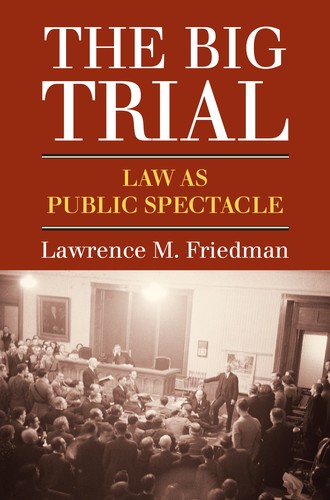
The Big Trial
0
0
As an Amazon Associate and affiliate partner, Menrva Books earns from qualifying purchases. Learn more
Author Description
The trial of O.J. Simpson was a sensation, avidly followed by millions of people, but it was also, in a sense, nothing new. One hundred years earlier the Lizzie Borden trial had held the nation in thrall. The names (and the crimes) may change, but the appeal is enduring - and why this is, how it works, and what it means are what Lawrence Friedman investigates in The Big Trial. What is it about these cases that captures the public imagination? Are the "headline trials" of our period different from those of a century or two ago? And what do we learn from them, about the nature of our society, past and present? To get a clearer picture, Friedman first identifies what certain headline trials have in common, then considers particular cases within each grouping. The political trial, for instance, embraces treason and spying, dissenters and radicals, and, to varying degrees, corruption and fraud. Celebrity trials involve the famous -- whether victims, as in the case of Charles Manson, or defendants as disparate as Fatty Arburkle and William Kennedy Smith -- but certain high-profile cases, such as those Friedman categorizes as tabloid trials, can also create celebrities. The fascination of whodunit trials can be found in the mystery surrounding the case: Are we sure about O.J. Simpson? What about Claus von Bulow - tried, in another sensational case, for sending his wife into a coma? An especially interesting type of case Friedman groups under the rubric worm in the bud. These are cases, such as that of Lizzie Borden, that seem to put society itself on trial: they raise fundamental social questions and often suggest hidden and secret pathologies. And finally, a small but important group of cases proceed from moral panic, the Salem witchcraft trials being the classic instance, though Friedman also considers recent examples. Though they might differ in significant ways, these types of trials also have important similarities. Most notably, they invariably raise questions about
Menrva's Summary
THE THESIS
This book investigates the enduring public fascination with headline trials and what they reveal about society. Lawrence Friedman, a distinguished legal historian, examines the common threads and distinct characteristics of high-profile legal cases throughout history, from the Lizzie Borden trial to the O.J. Simpson case. He categorizes these trials into types such as political, celebrity, tabloid, whodunit, 'worm in the bud,' and those stemming from moral panic, using specific examples to illustrate his points. The analysis explores how these cases capture public imagination and what they collectively signify about societal values and anxieties, both past and present.
THE SCOPE MAP
- Analysis of the O.J. Simpson and Lizzie Borden trials as touchstones for public fascination with legal proceedings.
- Identification and categorization of headline trials into distinct types: political, celebrity, tabloid, whodunit, 'worm in the bud,' and moral panic.
- Exploration of specific cases within each category, including treason, dissent, corruption, fraud, famous defendants and victims, and sensational mysteries.
- Examination of 'worm in the bud' cases that put society itself on trial by raising fundamental social questions and revealing pathologies.
- Discussion of moral panic cases, exemplified by the Salem witchcraft trials and more recent instances.
- Comparative analysis of historical and contemporary headline trials to understand societal shifts and continuities.
- Investigation into the underlying reasons for the enduring appeal of sensational legal dramas.
THE AUTHORITY PERSPECTIVE
The book is recognized for its insightful analysis of high-profile legal cases and their societal implications. Friedman's categorization of trials provides a structured framework for understanding why these events capture public attention so intensely. The work is noted for its ability to connect historical trials with contemporary ones, offering a lens through which to view evolving social values and anxieties. It serves as a compelling examination of the intersection between law, media, and public consciousness.
Page Count:
225
Publication Date:
2015-01-01
ISBN-10:
070062077X
ISBN-13:
9780700620777
History
True Crime
Non-Fiction
Social Science
Law
Community Tags
Similar Books